The wolf is one of the few tattoo subjects that looks good in every style. You can do it tribal and it works. Realistic? Works. Japanese? Beautiful. Geometric, watercolor, fine line, blackwork: the wolf handles all of them.
That's great news in theory. In practice, it means you have a lot of choices to make. And not all wolf tattoo designs age the same way, suit the same body placements, or require the same kind of artist.
This guide goes through the major wolf tattoo styles one by one. For each one, I’ll cover what it looks like, where it works best on the body, how well it holds up over the years, and what kind of artist you should look for. If you already know what your wolf tattoo should mean, this is the next step: picking the right design to express it.
Table of Contents
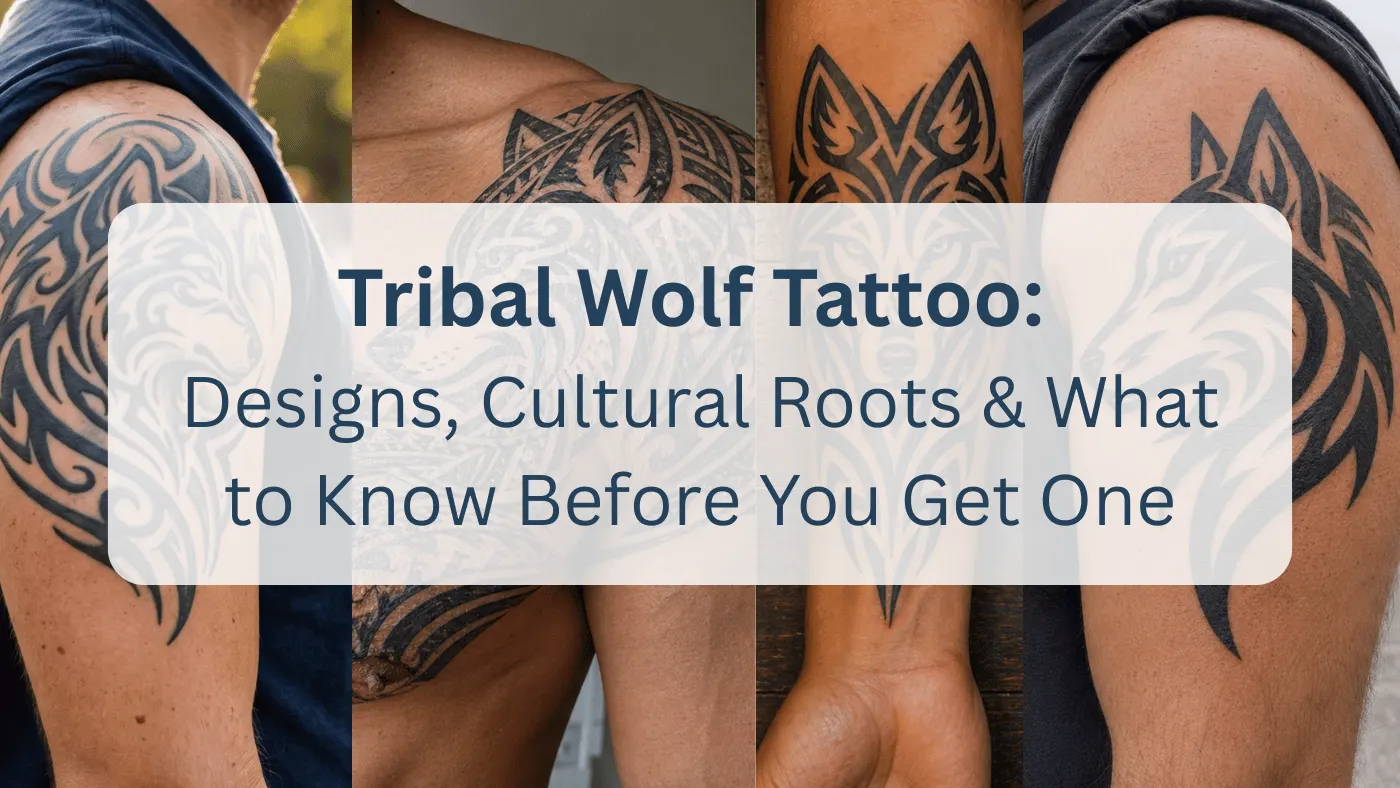
Tribal Wolf Tattoo
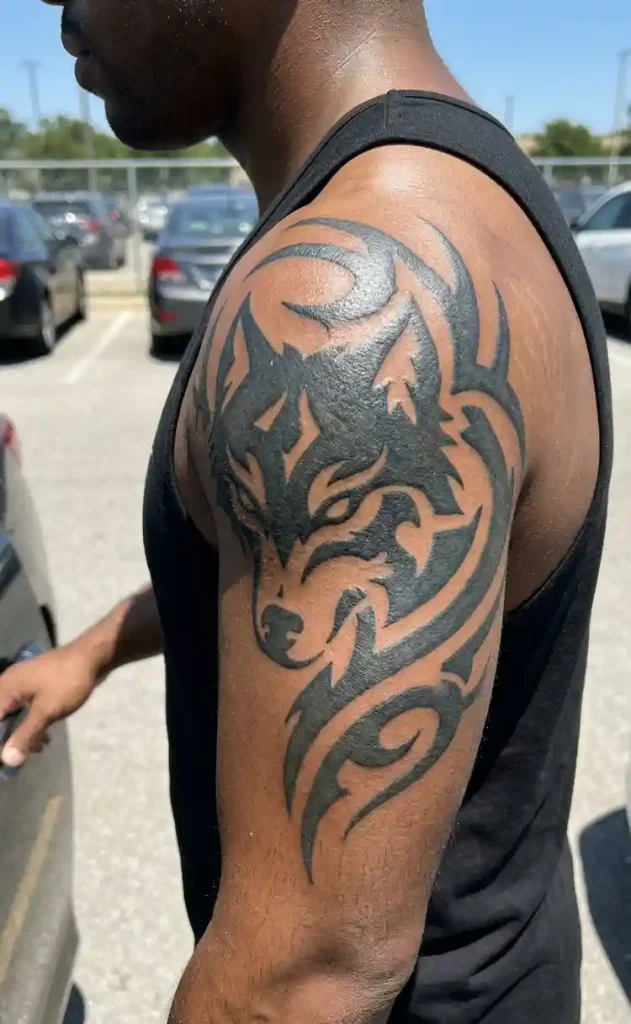
Tribal wolf tattoos use thick black lines, sharp angles, and negative space to form the wolf's shape. No shading, no color, no fine detail. Just bold black patterns on skin.
The main advantage is longevity. There's nothing to fade or blur: solid black ink holds better than anything else. A tribal wolf from 20 years ago still looks like a tribal wolf today. It's also faster and cheaper to tattoo than most other styles since there's less detail work involved.
The main risk is getting something generic. Tribal wolf designs have been heavily recycled online since the early 2000s. If you want one that actually looks good in 2026, find an artist who understands the cultural roots of tribal work: Polynesian, Maori, Haida, Borneo, and can create something specific to your body rather than copying a template.
Works best on: upper arm, shoulder, chest, calf. Needs room. Don't shrink it to a wrist.
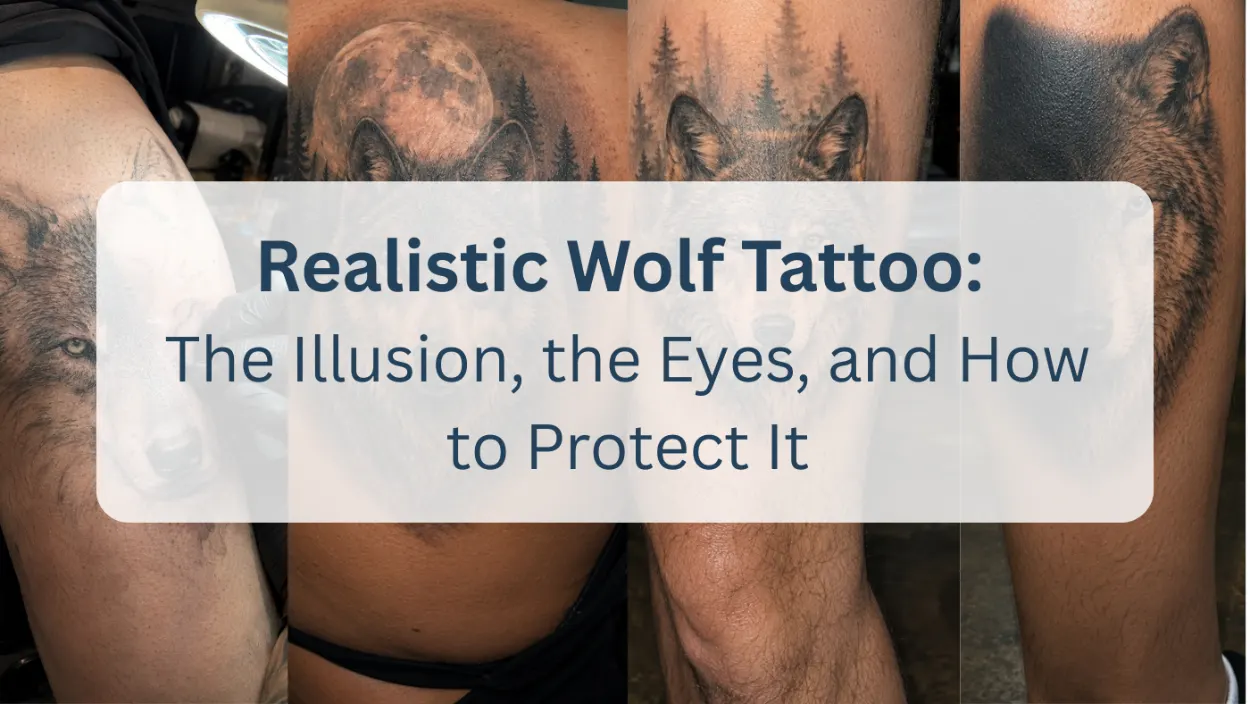
Realistic Wolf Tattoo
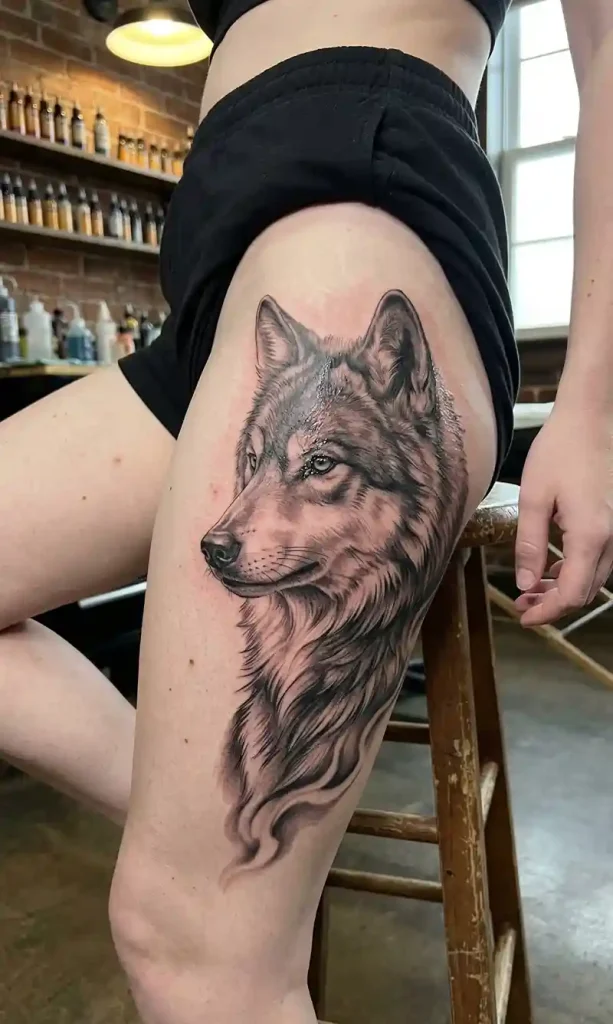
A good realistic wolf tattoo looks like a photograph on skin. Detailed fur, light in the eyes, shadows that actually follow the anatomy. When it's done well, it's the most impressive wolf tattoo style by far.
The catch: it's completely dependent on the artist. Realism is the hardest style to execute. A mediocre realism artist will give you a wolf that looks like a blurry dog. You need someone who specializes in realistic animal work and has a portfolio full of examples, not just one or two good ones.
On aging: realistic tattoos look amazing fresh but the fine details soften over time. Those individual fur strands blend together after 5 to 10 years, especially in smaller pieces. Go larger than you think you need and stick with black and grey. It holds better than color realism.
Works best on: forearm, upper arm, thigh, chest, back. Give the artist space.
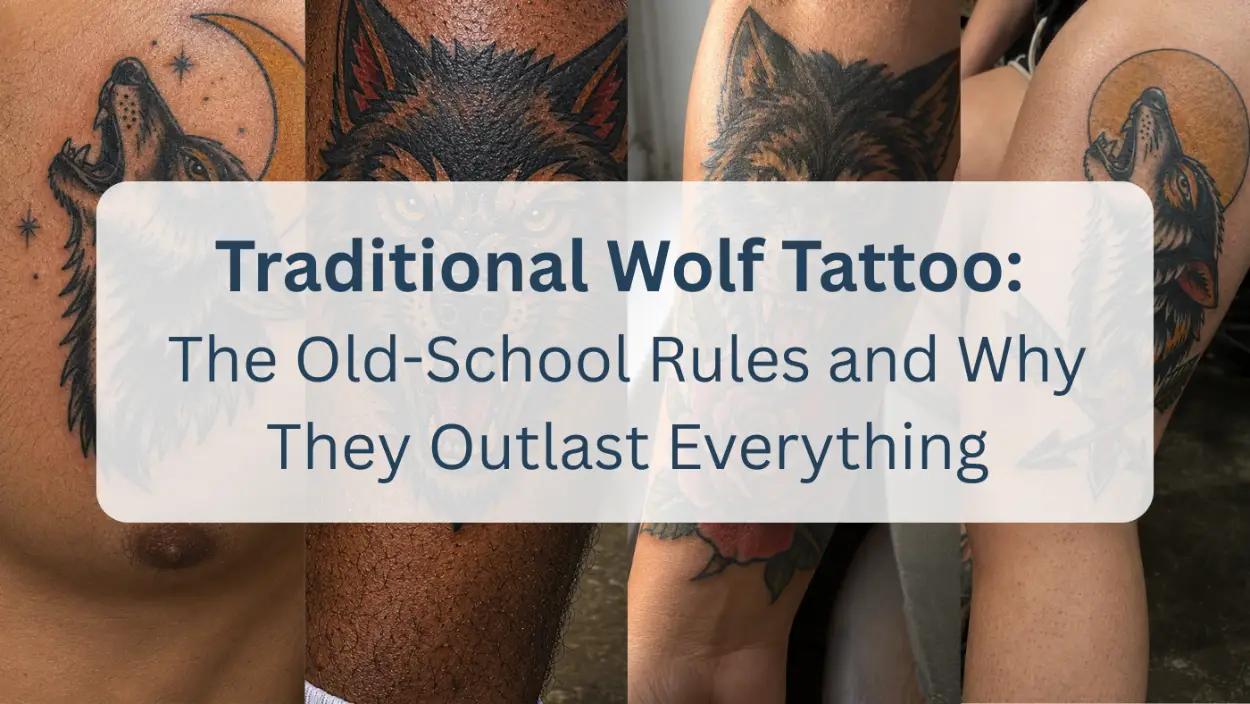
Traditional / American Traditional Wolf Tattoo
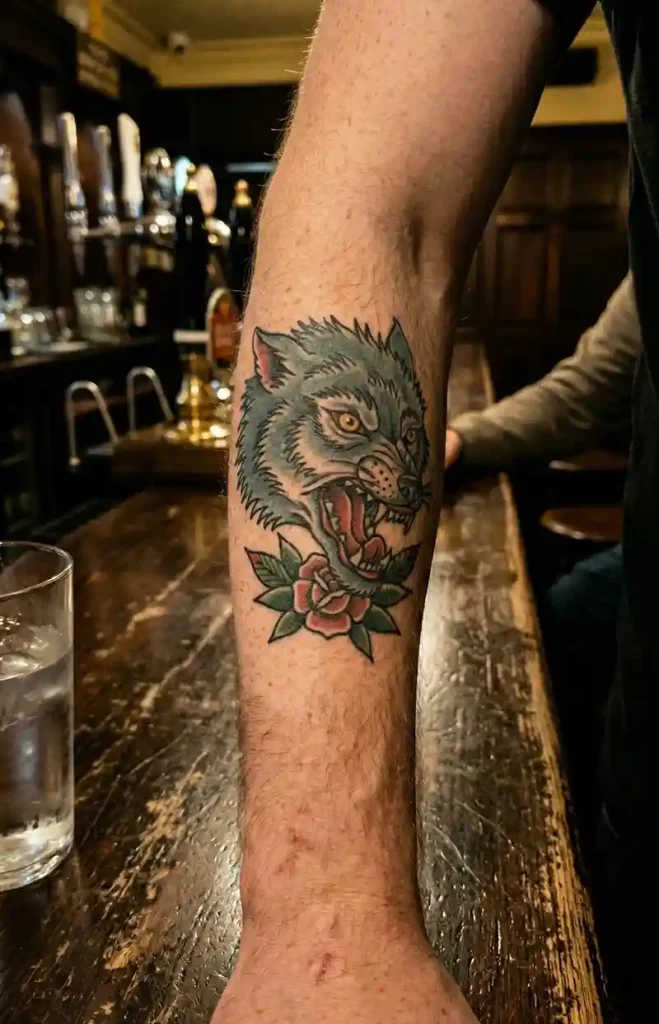
Bold outlines. Limited colors. Flat shading. No pretending to be anything other than a tattoo.
American traditional wolf tattoos follow the same rules that have kept sailor-era tattoo designs looking good for 80+ years. Thick black outlines hold everything together. Colors stay within their borders. The wolf head is usually front-facing or in profile, sometimes with a banner, dagger, or rose around it.
This style ages as well as tribal, arguably better, since the color adds visual interest while the outlines prevent everything from bleeding together. Most experienced tattoo artists are comfortable working in traditional, which also means it's easier to find someone good.
Works best on: forearm, upper arm, chest panel, shin. Great at medium sizes.
Japanese Wolf Tattoo
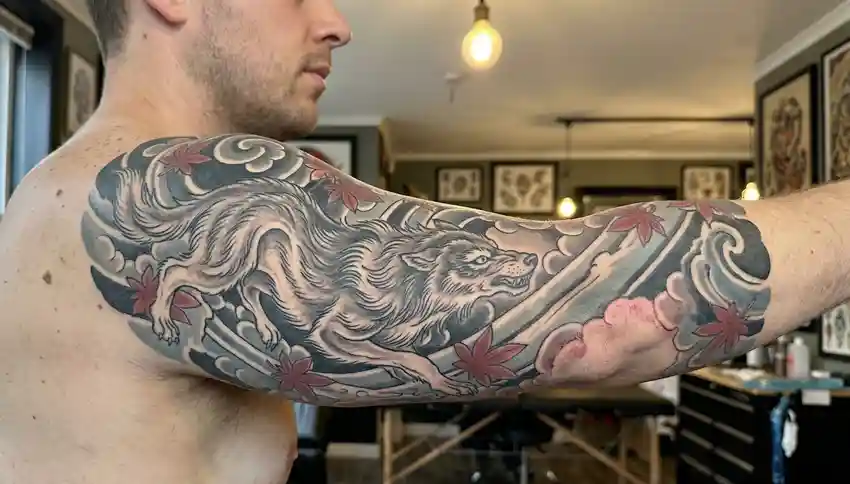
In Japanese tattooing, the wolf isn't a predator. It's a guardian. The Ōkami (which translates to "great god") protected travelers, villages, and harvests. Japanese wolf tattoos carry that energy: spiritual, protective, flowing.
The design conventions are specific. The wolf is usually shown in motion, surrounded by clouds, waves, wind bars, or maple leaves. The background is just as important as the subject. Everything flows together and follows the body's natural contours. Color palettes lean toward muted blues, greys, reds, and golds.
This is a style that works best big. Half sleeves, full sleeves, back pieces. A small standalone Japanese wolf on your wrist will look out of place. If this style interests you, plan for a larger piece and find an artist who actually studied or trained in Japanese tattooing. The composition rules matter and not everyone knows them.
Geometric Wolf Tattoo
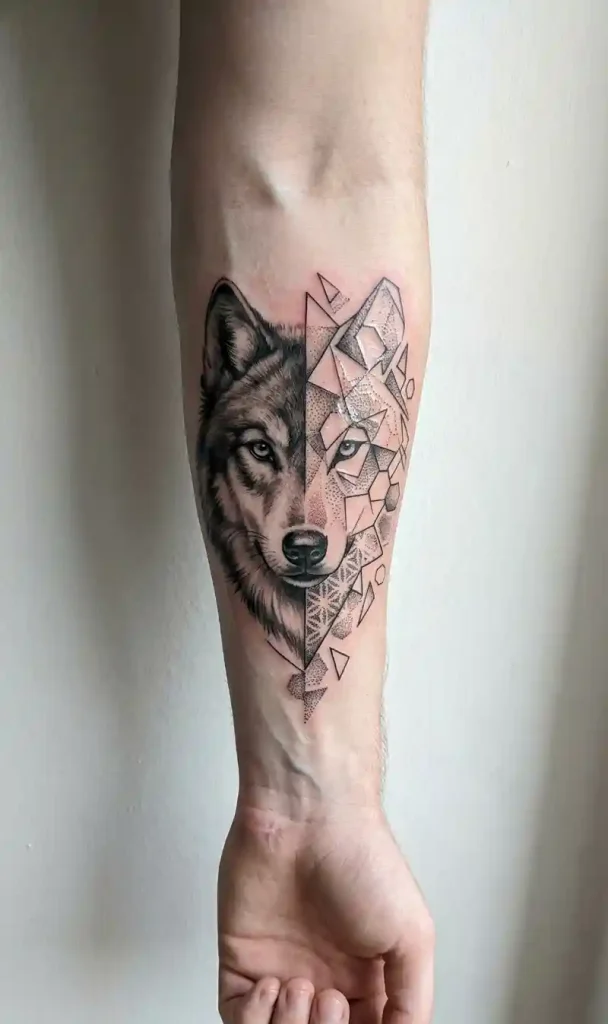
Geometric wolf tattoos break the animal into shapes: triangles, hexagons, clean straight lines. The wolf's form is reconstructed through precision rather than organic curves.
The most common version is the split design: one half of the wolf rendered realistically, the other half dissolved into geometric fragments. It looks striking and photographs well. Sacred geometry elements like the flower of life sometimes get worked into the background.
Fair warning: geometric wolves are very popular right now, and a lot of them look the same. Push your artist for something custom rather than accepting the first design that comes up when they search Pinterest. Also, geometric work depends on clean lines staying clean. Go a bit larger than you think you need, because even small spreading dulls the precision.
Works best on: forearm, upper arm, chest. Anywhere with a flat surface.
Celtic Wolf Tattoo
Celtic wolf designs weave the animal through interlocking knotwork patterns, those endless loops that represent eternity and interconnection. Sometimes the whole wolf is built from knots. Sometimes a realistic head emerges from an abstract knotwork body.
If you have Celtic or Irish roots, this is a way to connect your heritage to your tattoo. The wolf in Celtic tradition was a guide between the physical and spiritual worlds. The combination of that symbolism with the knotwork aesthetic gives these tattoos real depth.
The execution is tricky. Every knot has to weave correctly, over, under, over, under, or it looks wrong. A good Celtic tattoo artist will spend a lot of time on the stencil before starting.
Works best on: upper arm, forearm, shoulder blade, calf. Knotwork wraps around limbs naturally.
Viking & Norse Wolf Tattoo
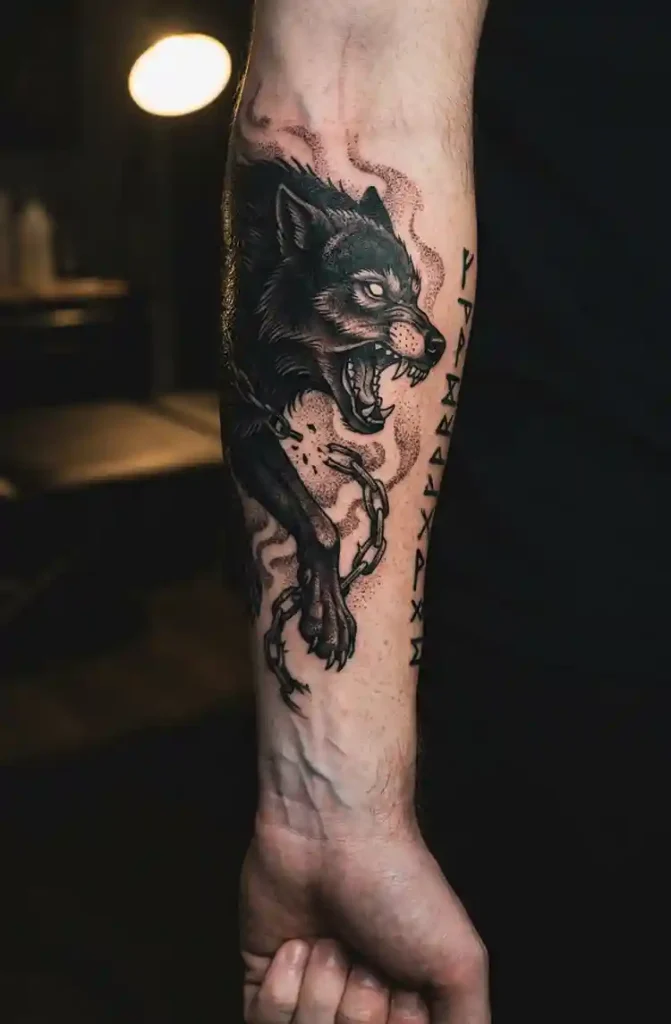
Norse wolf tattoos pull from mythology. Fenrir breaking his chains. Geri and Freki at Odin's side. Sköll chasing the sun. The aesthetic is dark, heavy, and aggressive: blackwork, rune lettering, weathered textures, chain elements.
These are wolf tattoo designs that feel like they belong in a story. The wolf isn't just an animal here. It's a mythological force. Designs tend to be larger and more detailed than typical wolf tattoos because there's usually a narrative element built in.
One thing to watch for: there's a lot of overlap online between Norse, Celtic, and generic "Viking" designs. They're actually distinct traditions. If you want Fenrir, make sure your artist knows who Fenrir is and isn't just drawing a regular wolf with some runes around it.
Neo-Traditional Wolf Tattoo
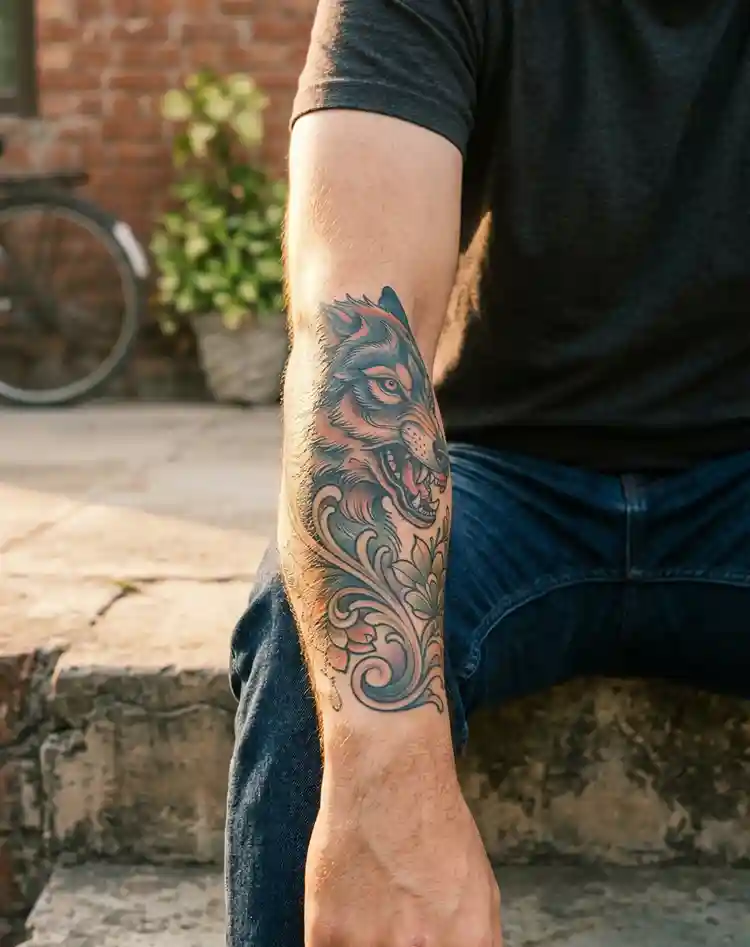
Take traditional's bold outlines and add richer colors, more complex shading, and finer detail. That's neo-traditional.
The outlines keep the structure that makes traditional tattoos age-proof. But inside those outlines you get smoother gradients, more realistic features, and an illustrative quality that traditional can't achieve. It's the best of both worlds for a lot of people.
If you're not sure what style to go with, neo-traditional is a safe bet. It looks good, it lasts, it works at different sizes, and most experienced artists are comfortable with it. Not flashy, just reliable.
Works best on: pretty much any placement. One of the most versatile styles.
Watercolor Wolf Tattoo
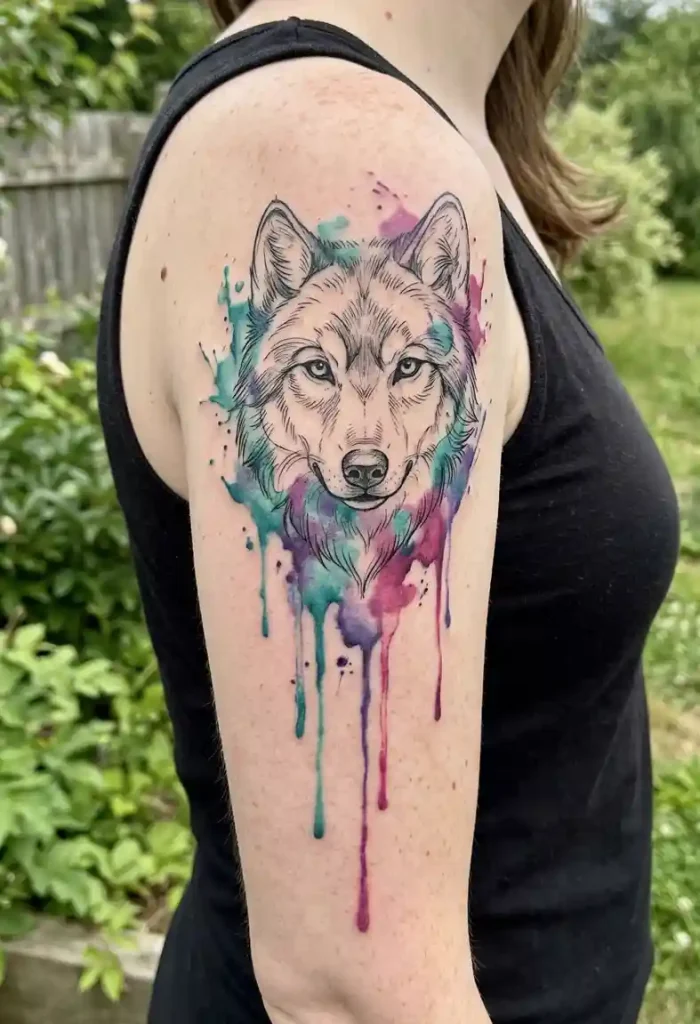
Watercolor tattoos mimic the look of paint on paper: loose color bleeds, drips, splashes extending past the wolf's edges. Visually, it's one of the most striking wolf tattoo designs you can get.
The honest truth about aging: pure watercolor tattoos without a black ink foundation fade fast. Those soft color edges blur and lose vibrancy within a few years. The smart approach is to get a watercolor-style wolf with solid black linework underneath. The structure holds even as the color softens.
Sun exposure makes it worse, so placement matters. Shoulders, upper arms, thighs, and back (areas you can keep covered) will last longer than forearms or wrists that see sun every day.
Minimalist & Fine Line Wolf Tattoo
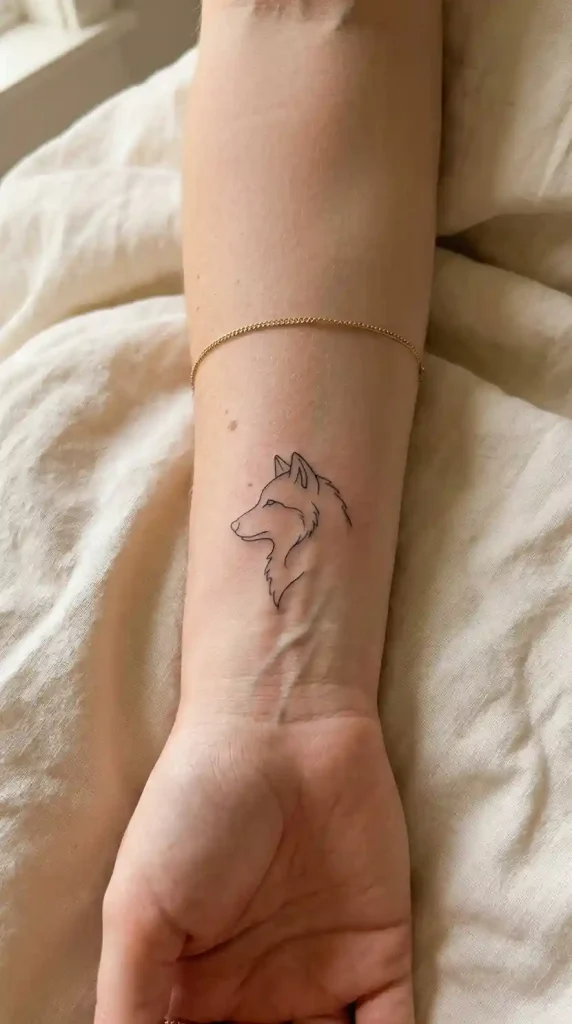
Strip the wolf down to its simplest form. A few clean lines. Maybe one continuous stroke. Just enough to read as a wolf and nothing more.
Minimalist wolf tattoos are popular with people getting their first tattoo or anyone who prefers something small and subtle. They're less painful (less ink), less expensive, and fit in places where a bigger design wouldn't work: wrist, ankle, behind the ear, inner forearm.
Fine line work uses very thin needles to create delicate, precise lines. The results look sharp and elegant, but thin lines spread more than thick ones over time. What looks razor-clean at year one will soften by year five. Touch-ups help, but this style needs more maintenance than bolder approaches.
Blackwork Wolf Tattoo
All black. No grey wash, no color. Solid black ink and negative space create the wolf's form. The skin itself becomes the highlights.
Blackwork hits hard visually. There's a weight and intensity to it that other styles don't have. And it ages beautifully: solid black deepens and settles over time rather than fading.
The tradeoff is pain and healing. That much solid black means a lot of ink going in, which means longer sessions and slower recovery. Worth it if the look speaks to you.
Abstract Wolf Tattoo
Abstract wolf designs don't follow any template. The wolf might be suggested through fragmented shapes, loose brushstrokes, splattered ink, or deconstructed forms where you have to look twice to see the animal.
When it works, it's the most original wolf tattoo you'll see. When it doesn't, it's a mess. This style depends almost entirely on finding the right artist, someone who thinks in abstract terms naturally, not a realism artist experimenting. Look at their full portfolio, not just wolf pieces.
Wolf Tattoo Designs: Style Comparison
Quick reference for all twelve styles.
| Style | Look | Aging | Best Placements | Artist Difficulty |
|---|---|---|---|---|
| Tribal | Bold black shapes, sharp edges | Excellent | Arm, shoulder, chest, calf | Medium |
| Realistic | Photographic fur, depth, detail | Good (large) / Fair (small) | Forearm, thigh, chest, back | High |
| Traditional | Bold outlines, flat color, classic | Excellent | Forearm, arm, chest, shin | Medium |
| Japanese | Flowing, mythological, full scenes | Very good | Sleeve, back, thigh | High |
| Geometric | Shapes, precision, mathematical | Good if sized right | Forearm, arm, chest | Medium-high |
| Celtic | Knotwork, interlocking loops | Very good | Arm, forearm, shoulder, calf | Medium-high |
| Norse | Dark, heavy, mythological | Very good | Forearm, chest, back | Medium |
| Neo-Traditional | Bold outlines + rich color | Very good | Most placements | Medium |
| Watercolor | Color splashes, paint effects | Fair, needs touch-ups | Shoulder, arm, thigh, back | High |
| Minimalist | Clean thin lines, simple | Fair, lines spread | Wrist, ankle, forearm, ear | Medium |
| Blackwork | Solid black, negative space | Excellent | Forearm, chest, arm | Medium |
| Abstract | Deconstructed, fragmented | Varies | Arm, back, thigh | Very high |
Picking the Right Wolf Tattoo Design
Three things to think about.
Meaning. If your wolf represents cultural heritage, a style rooted in that culture (Celtic, Norse, Japanese, tribal) makes sense. If it's personal rather than cultural, choose based on what you like visually.
Placement. Large body areas (back, chest, thigh, sleeve) can handle any style. Small areas (wrist, finger, ankle) need minimalist or simple blackwork. Trying to cram a detailed realism wolf into 3 inches will look muddy in a few years.
Longevity. If you want zero-maintenance ink that looks the same in 20 years, go tribal, traditional, or blackwork. Willing to do periodic touch-ups? Watercolor and fine line open up. Realism and geometric are somewhere in the middle.
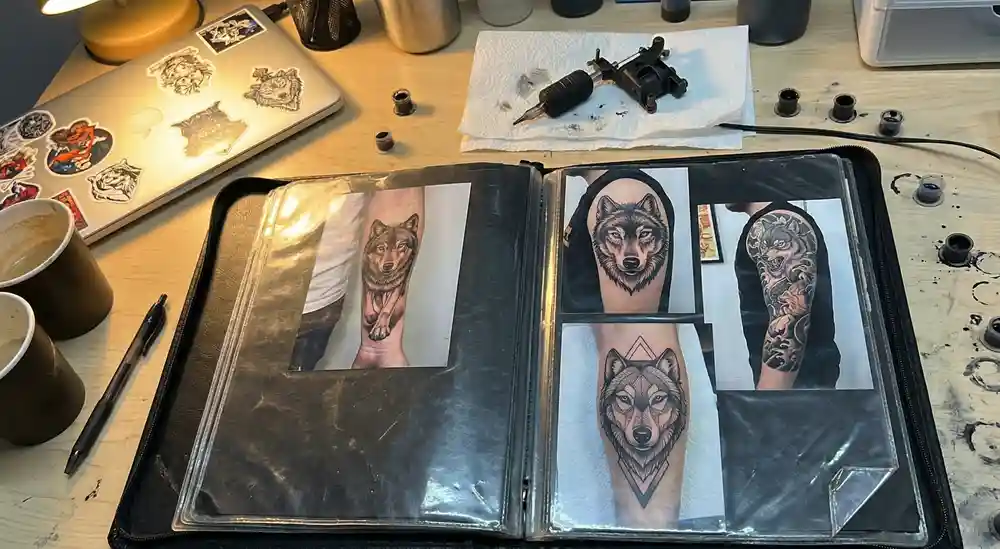
And the one rule that applies to every style: look at portfolios. Not one or two pieces. Dozens. If an artist's wolf work in your chosen style consistently looks great, book them. If you're scrolling past mediocre work to find one good piece, keep looking.
Frequently Asked Questions
Q: What is the best wolf tattoo style?
It depends on what matters most to you. For longevity: tribal, traditional, or blackwork. For visual impact: realism or Japanese. For artistic expression: watercolor or abstract. If you can't decide, neo-traditional is the safest all-around option. It looks good, ages well, and works at most sizes.
Q: Which wolf tattoo style ages best?
Tribal, American traditional, and blackwork. All three use thick lines and solid black ink that holds its shape for decades. Realistic ages well when done large. Watercolor and fine line fade the fastest and usually need touch-ups within 3 to 5 years.
Q: How much do wolf tattoo designs cost?
Small minimalist: $100 to $250. Medium traditional or geometric: $300 to $700. Large realistic or Japanese sleeve: $1,500 to $3,000+. Prices depend on artist, location, and complexity. Don't choose an artist based on price.
Q: Can you combine wolf tattoo styles?
Yes, and some of the best wolf designs do exactly that. Realistic face with geometric fragments. Traditional wolf with Japanese-style background. Blackwork wolf with watercolor accents. Make sure your artist has experience blending the specific styles you want.
Q: What wolf tattoo style is best for a first tattoo?
Neo-traditional or minimalist. Neo-trad gives you impact with good aging. Minimalist keeps it simple, less painful, and less of a time commitment. Large realism pieces are better saved for later. The sessions are long and the aftercare is demanding.
Same Wolf, Different Tattoo
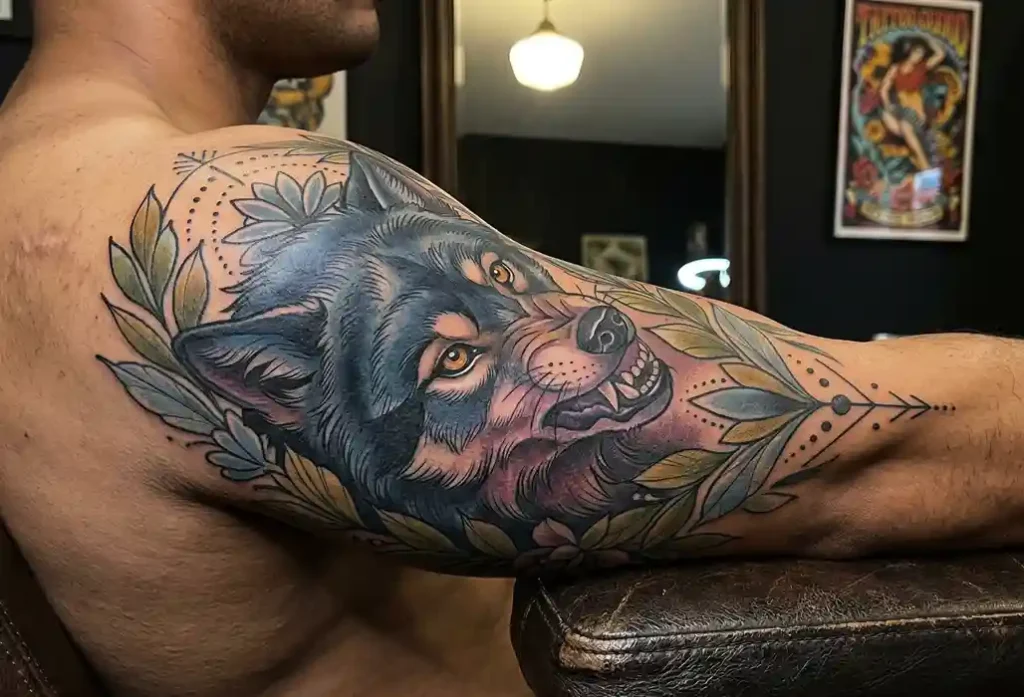
Every style on this list takes the same animal and turns it into something different. A tribal wolf and a watercolor wolf don't look like the same creature. A Japanese guardian spirit and a Norse mythological monster share a name but nothing else.
The right wolf tattoo design matches your meaning, fits your body, and comes from an artist who's genuinely good at that specific style. Get all three right and you'll have a piece you're happy with for a long time.
Check out our deeper guides on each individual style for more examples and artist-finding tips. And if you're still figuring out the symbolism side, our wolf tattoo meaning guide covers every variation.