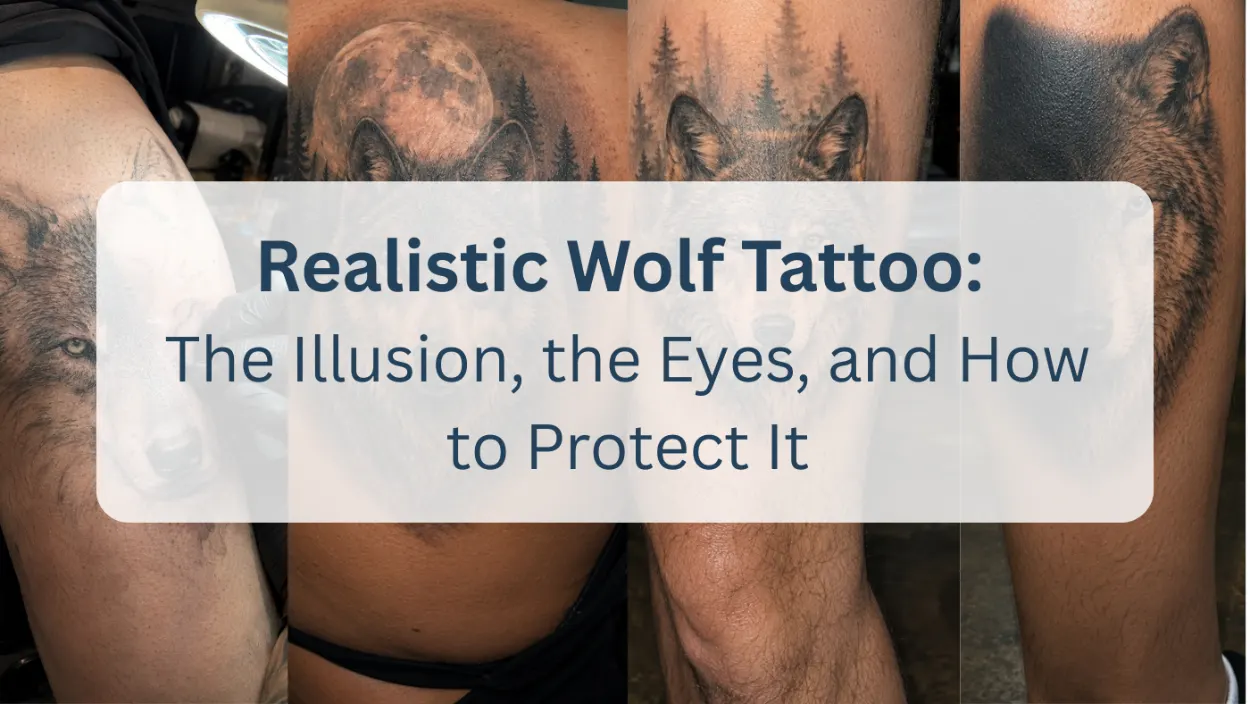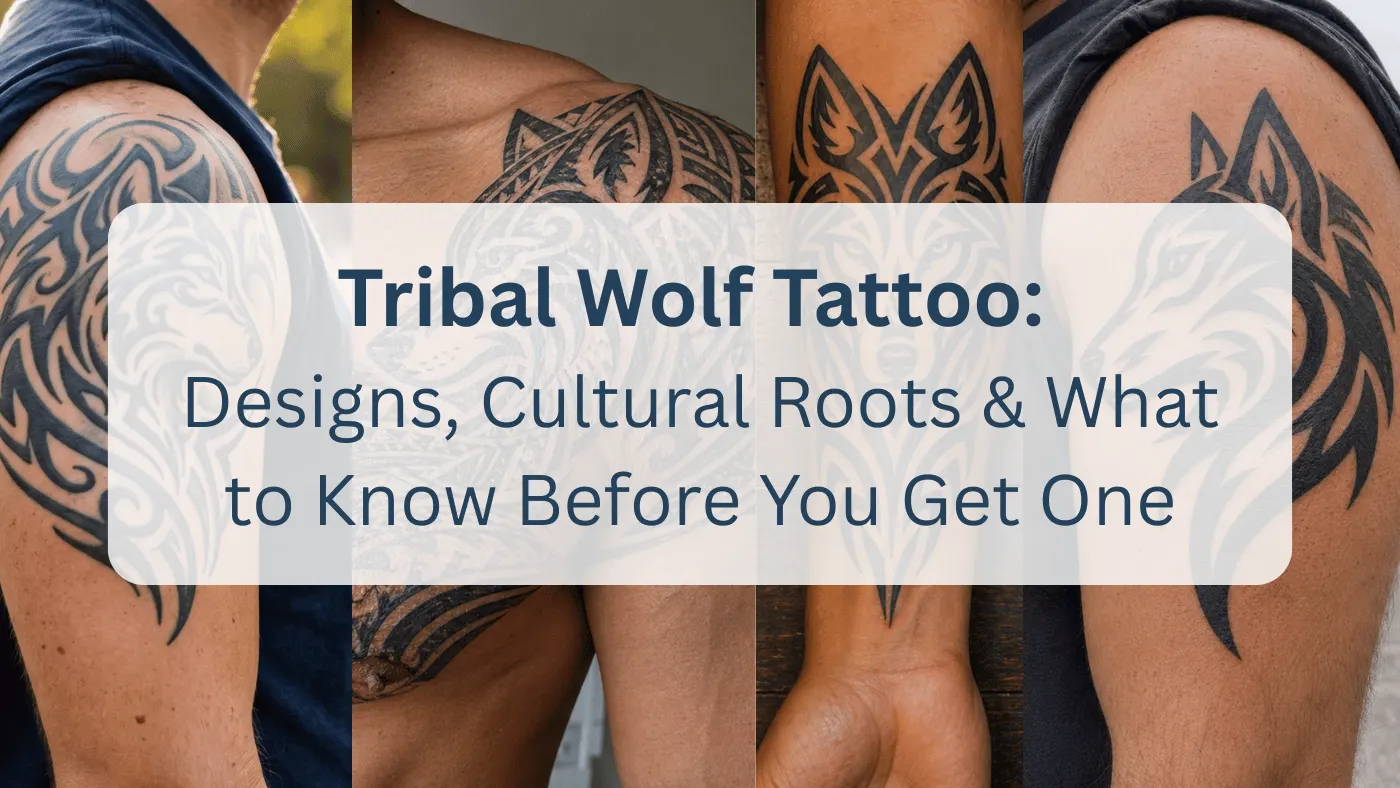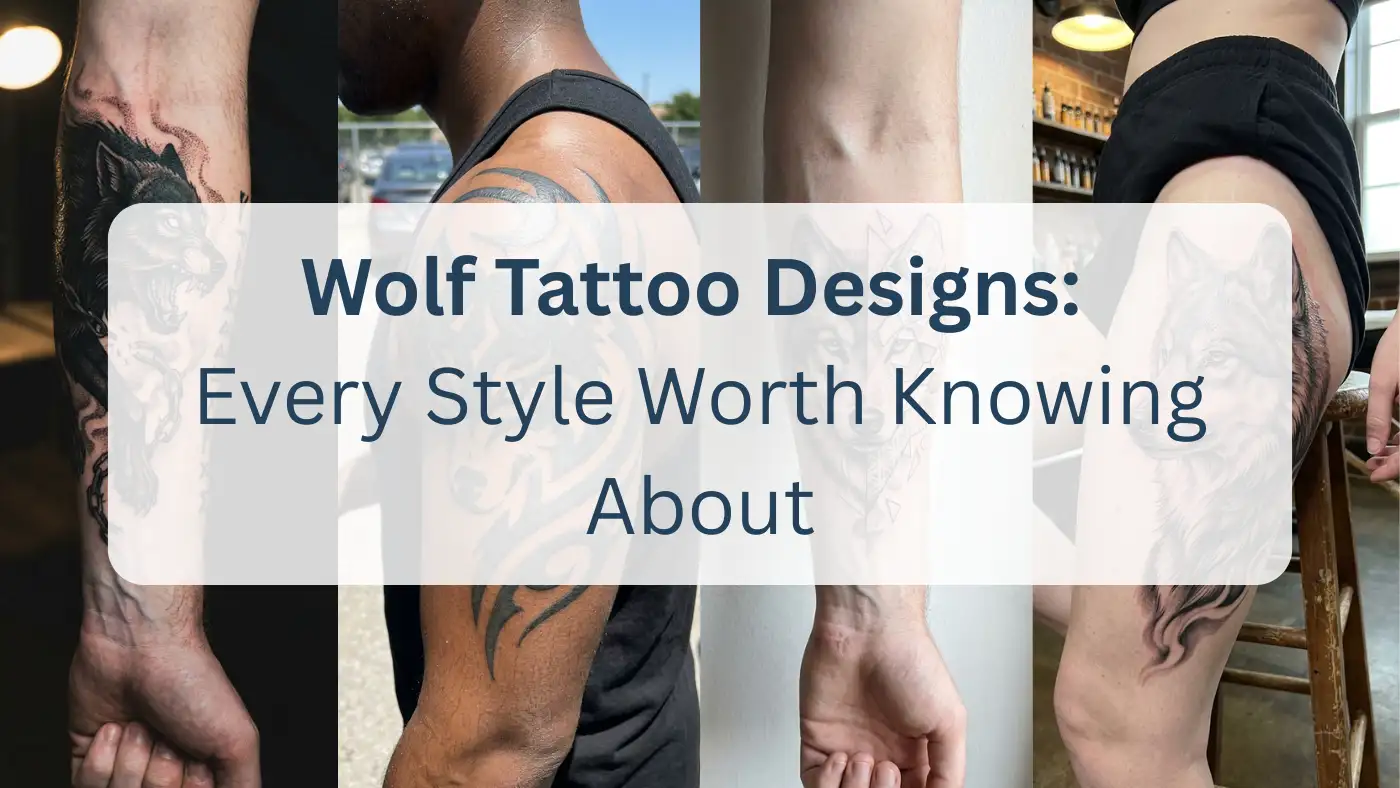
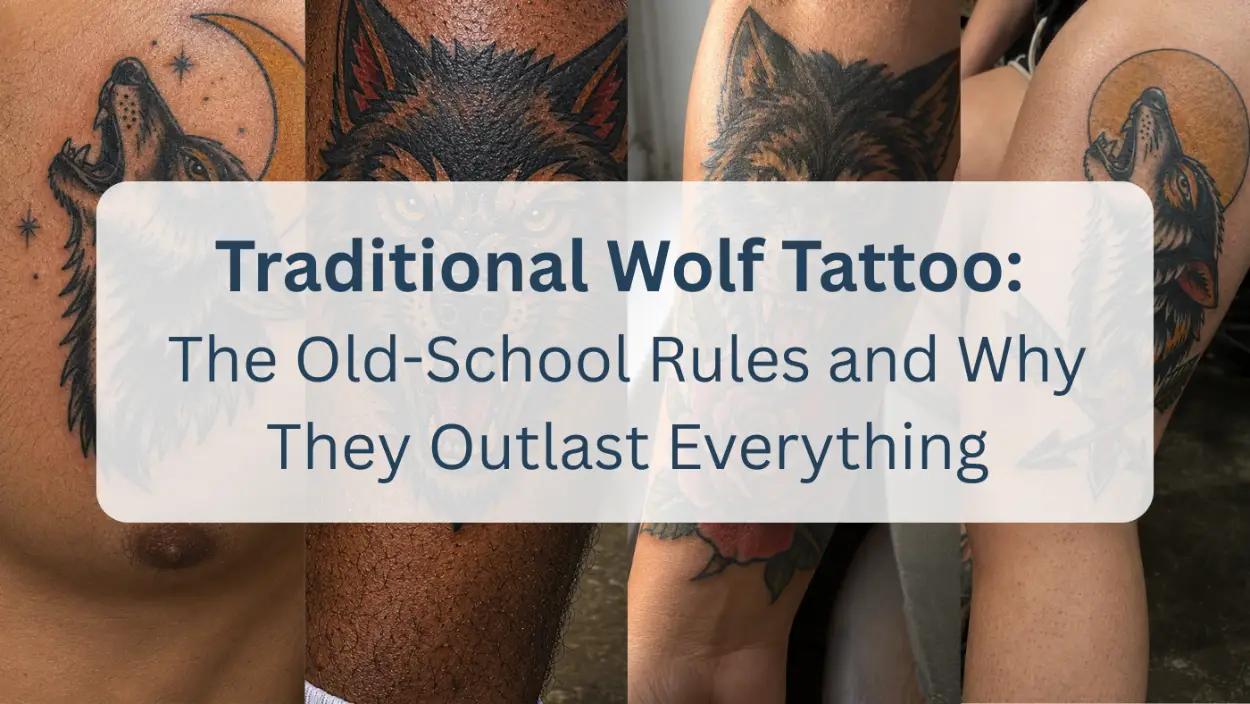
Most people who search for a traditional wolf tattoo are really searching for a vibe. Bold, retro, a little rebellious, the kind of thing that looks like it belongs on a forearm in a black-and-white photo from 1955. That instinct is correct, but it stops one layer too early. Traditional is not a vibe you pick off a mood board. It is a roughly 100-year-old rulebook, and almost every rule in it exists for one reason: the tattoo has to still look good in 30 years.
The wolf is a relatively modern guest in that grammar. Sailors were not getting wolves in the 1940s the way they were getting swallows and anchors. So a traditional wolf is a real design problem: take an animal with a complicated face and force it to obey rules written for simpler shapes. Done right, it is one of the most durable tattoos you can get. Done wrong, it is a muddy portrait pretending to be old-school.
This guide is the part nobody else writes. Not a gallery of 60 pictures, but the actual rules of the style, how a wolf fits inside them, and why this is the one wolf style with a real argument for outlasting all the others. It sits in the styles section of the broader wolf tattoo designs pillar, and if you want the symbolism behind the animal before you commit to a look, the wolf tattoo meaning guide covers that side first.
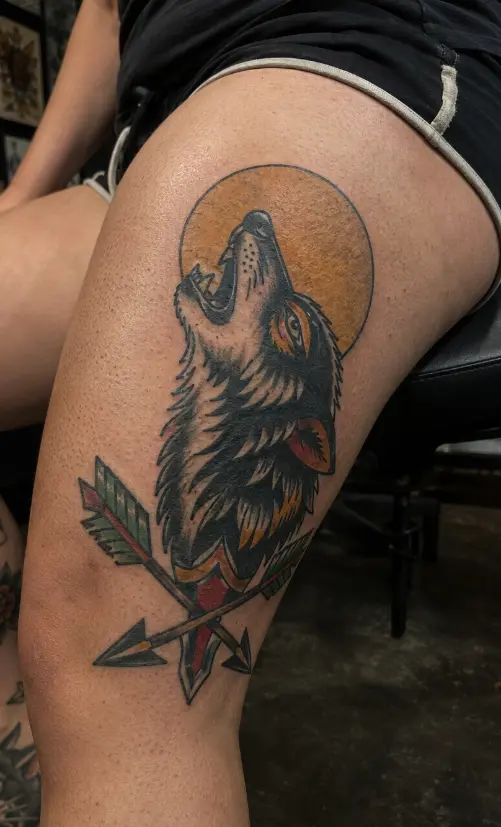
Table of Contents
What "Traditional" Actually Means (and the Styles People Confuse It With)
American traditional, also called old school, is the style that mid-20th-century sailors made famous and that Norman "Sailor Jerry" Collins codified into a craft. According to Wikipedia's profile of Sailor Jerry, Collins reworked 1920s and 1930s designs with Japanese influence, developed his own pigments and needle groupings, and turned a loose folk practice into a disciplined visual language. That language has a fixed look: heavy black outlines, a small bright palette, solid black shading, and bold iconic imagery you can read from across a room.
It gets confused with three things it is not. Neo-traditional wolf tattoo work keeps the bold outline but adds a wider color range, softer dimensional shading and far more detail, so it reads richer and more illustrative. A tribal wolf tattoo is a different lineage entirely, built from solid black pattern and negative space rather than outline-and-fill. And a realistic wolf tattoo is the opposite philosophy: smooth gradients, photographic depth, no visible outline at all. If you want one sentence to keep them straight: traditional commits to the outline and the limited palette on purpose, neo-traditional loosens both, tribal removes the outline for pattern, and realism removes it for depth.
The Five Rules That Make a Wolf Traditional
If you understand these five rules, you can look at any wolf tattoo and tell whether it is genuinely traditional or just borrowing the costume. They are also the brief you should hand your artist.
Rule 1: The Bold Black Outline Is Non-Negotiable
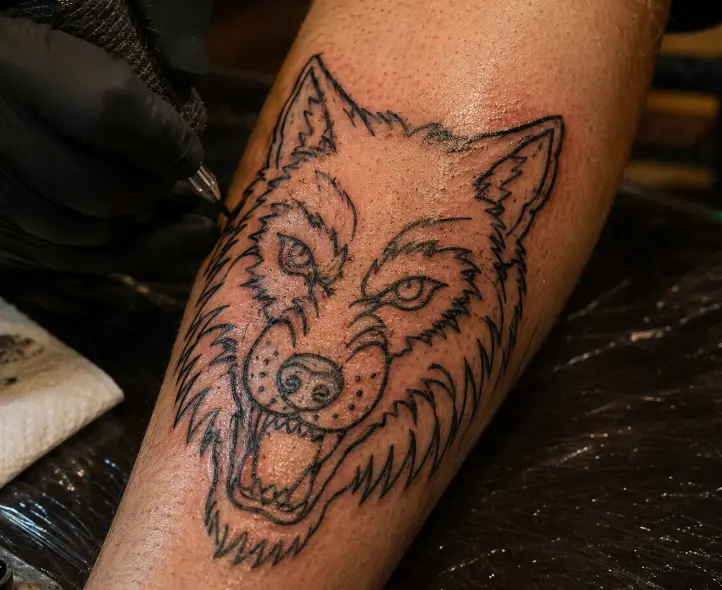
Every element gets a heavy, confident, even-weight black outline. Not a sketchy line, not a thin one. The outline is the skeleton that holds the tattoo together as skin ages and ink spreads. A traditional wolf with a timid outline is already failing rule one, and it will look worse every year, not better.
Rule 2: A Small, Classic Palette
Old-school color is deliberately limited: a brick or fire red, a mustard or ochre yellow, a sage or olive green, sometimes a muted blue, all anchored by black. That restraint is not a lack of imagination. A tight palette of strong, opaque colors holds up far better over decades than a wide range of subtle blended tones, which is exactly why the style settled on it. Pick the wolf's accents from that box (a red tongue, a yellow eye, a green leaf on a rose) rather than trying to color a naturalistic grey wolf.
Rule 3: Solid Black and Whip Shading, Never Realism Gradients
Traditional shading is solid black areas and simple graded "whip" shading, not the smooth photographic gradients of realism. On a wolf this means the fur is suggested with bold black shapes and a few confident grey passes, not thousands of tiny strands. If your reference looks like a wildlife photograph, you are describing realism, not traditional.
Rule 4: Read It From Across the Room
Iconic beats intricate. A traditional wolf is a strong silhouette and a clear expression, not a hyper-detailed muzzle. The test Sailor Jerry's whole generation worked to: it should still read clearly at arm's length and at a glance. Detail that disappears at three feet is detail that will blur into mud at year ten anyway.
Rule 5: Motifs and Filler That Belong
Traditional wolves rarely travel alone. They come with old-school furniture: a rose, a dagger, a banner, a moon, crossed arrows, a horseshoe, a snake. These are not random decoration. They balance the composition and they carry the style's symbolic shorthand. The wolf in sheep's clothing is a genuinely old motif worth knowing, and a wolf with a banner of a name or a date is the classic way traditional handles a memorial without breaking the rules. The Wikipedia overview of wolves in folklore and mythology is a useful primer if you want the filler to mean something rather than just fill space.
The Wolf in the Tradition: Designs That Actually Work
Within those rules, a handful of wolf compositions are proven. These are not a listicle of poses, they are the ones that obey rule four and survive rule three.
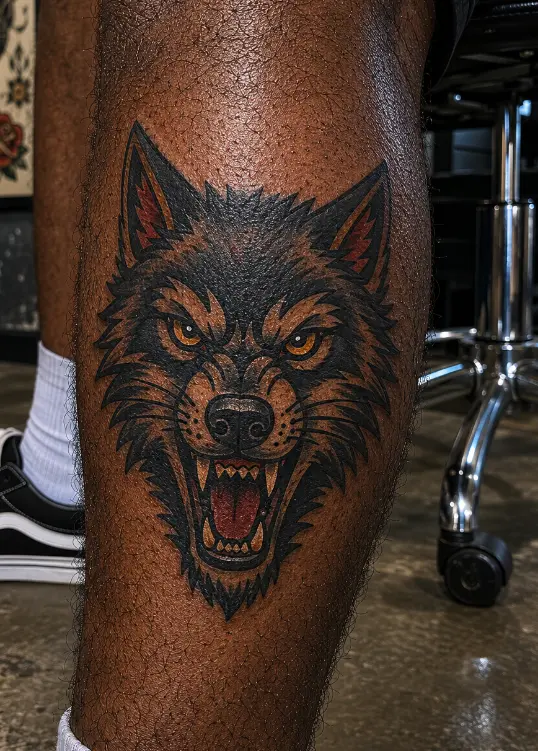
The traditional wolf head. The bread and butter. A bold three-quarter or front head, strong outline, flat fill, often with a red tongue and a single accent. The broader wolf head tattoo guide covers portrait quality in general; in the traditional version, simplicity is the feature, not a compromise.
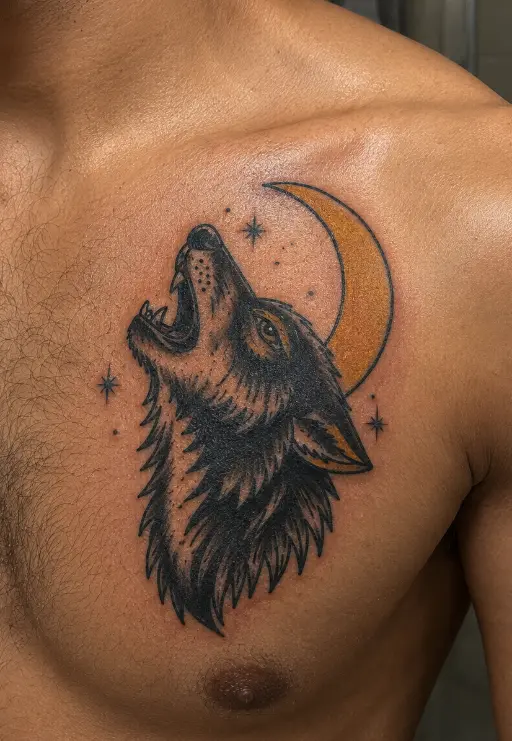
The howling wolf with a moon. The most naturally old-school wolf composition, because the moon is a clean bold shape that rule four loves. In traditional, keep the moon solid and the wolf graphic and it almost designs itself.
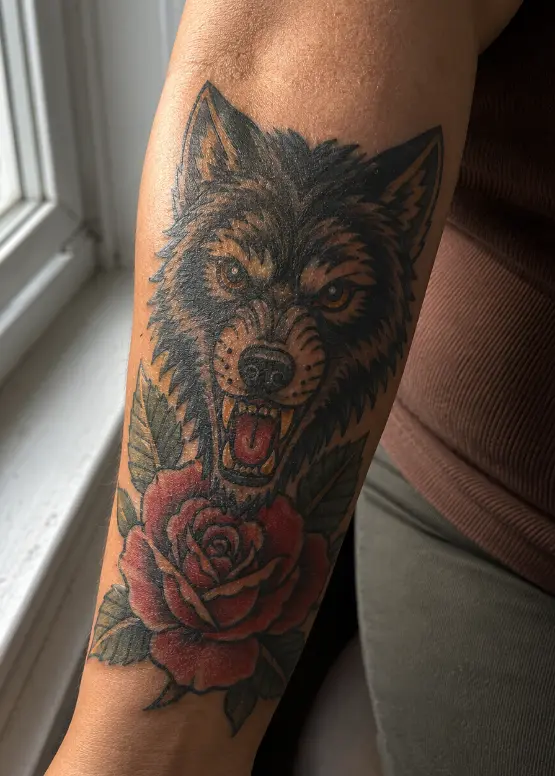
Wolf and dagger, wolf and rose, wolf and banner. The classic combinations. The dagger adds edge and an easy vertical, the rose adds the palette's signature red, and the banner is how old-school carries words. Each one is a rule-five motif that genuinely belongs with a wolf rather than being bolted on.


The Longevity Argument: Why a Traditional Wolf Wins at 20 Years
Here is the case for choosing this style over a flashier one. Every tattoo fights two slow enemies: ink spreading microscopically under the skin over decades, and ultraviolet light breaking the pigment down. A PMC review on tattoo sun exposure ties consistent UV exposure directly to premature fading and line breakdown. Fine, low-contrast detail loses that fight first. It is the first thing to blur and the first thing to wash out.
Traditional is engineered around exactly that problem. Heavy outlines stay legible even after the line softens. Solid black holds its shape when subtle grey would have faded to nothing. A tight, high-contrast palette survives UV better than blended pastels. This was not an accident of taste. The artists who built the style, Sailor Jerry's circle included, were deliberately designing tattoos to age gracefully and keep their integrity for life, because their clients were sailors who would not be back for touch-ups. You are buying a hundred years of that field testing.
None of this means traditional is maintenance-free. It means it degrades slowly and gracefully instead of quickly and badly. A bold traditional wolf at year 20 looks like an older bold traditional wolf. A fine-line realistic wolf at year 20 can look like a bruise. If you only get one wolf in your life, the style's resilience is a real reason to pick it.

Color or Black and Grey?
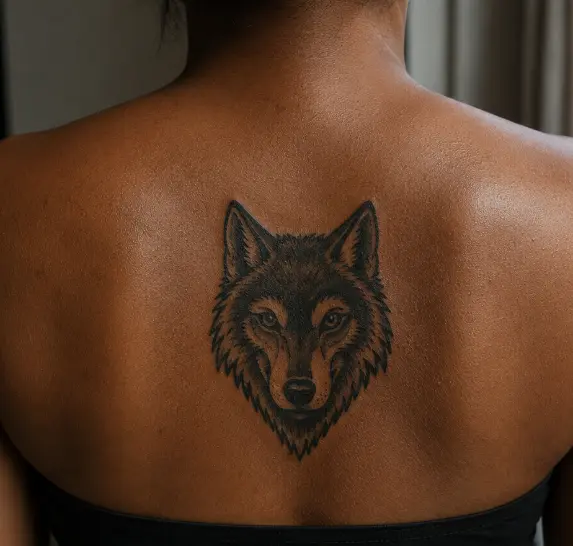
Traditional is historically a color style, and full-color old-school is what most people picture. But a black-and-grey traditional wolf is a legitimate choice and increasingly common. It keeps every structural rule (bold outline, solid black, iconic shapes, read-from-across-the-room clarity) and simply drops the palette. The trade-off is honest: black-and-grey traditional is slightly more subtle and arguably ages even more predictably, because there is no color to shift, but it loses the unmistakable old-school punch that the red and yellow give. Neither is wrong. If you want maximum longevity and a quieter look, go black-and-grey. If you want the full historical statement, commit to the color.
Placement and Size: Traditional Needs Room
Bold outlines and solid black need space to breathe, so traditional has a minimum viable size that finer styles do not. Below roughly three inches the outline and the fill start to merge into a black blob within a couple of years. The full reasoning by body area is in the wolf tattoo placements pillar, but the short version for this style is specific. The wolf forearm tattoo is the historically correct home of old-school work and still the best default. A traditional wolf sleeve tattoo is one of the few places the style truly sings, because the bold motifs tile together into a classic sleeve better than any other style. And if you were hoping for something tiny, be honest with yourself: a sub-two-inch traditional wolf is fighting the style's own rules.
Finding an Artist Who Genuinely Does Traditional
This matters more in traditional than in almost any other style, because traditional looks deceptively simple and is not. Clean even outlines, perfectly solid black with no patchiness, and confident shape language are hard, and they are unforgiving when done by someone who mostly does realism or fine line. A realism artist's traditional wolf often has a hesitant outline and over-worked shading. It will read as a costume.
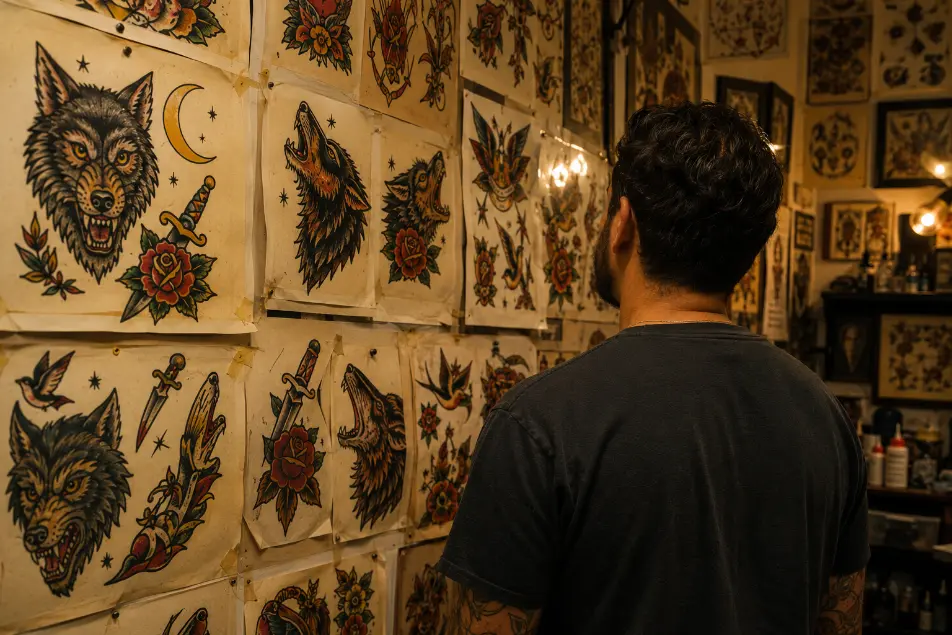
Vet for three things. A real traditional portfolio (not a few trad pieces between realism work, an actual body of old-school tattoos). Healed photos, ideally several years old, where the black is still solid and the lines are still crisp. And genuine flash, hand-drawn classic designs on the wall or in a book, which signals an artist who lives in the tradition rather than visiting it. If someone shows you only fresh photos and no flash, keep looking.
What Goes Wrong With Traditional Wolves
Five mistakes account for most disappointing traditional wolves, and none of them are about taste.
- Treating it as the cheap, easy style. "It's just bold lines" is wrong. A great traditional wolf is one of the hardest things to do well precisely because there is nowhere to hide a shaky line or patchy black. Budget and choose accordingly.
- Going too small. The single most common error. The style has a floor. Take it under three inches and you are guaranteeing a blob in five years.
- Mixing styles into mush. A traditional wolf with realistic eyes and a watercolor splash is not a fusion, it is three styles arguing. Pick the tradition and stay inside its rules, or pick a different style honestly.
- Hiring the wrong artist. Covered above, and worth repeating. The right wolf style with the wrong specialist still fails.
- Over-personalizing away the clarity. Cramming names, dates, micro-detail and extra elements into a traditional wolf breaks rule four. The style's power is its readability. Protect it. This is as true for the designs in the wolf tattoos for men guide as it is for those in the wolf tattoos for women guide. The traditional rulebook does not change by audience, only the motif choices around the wolf do.
Aftercare: Protecting the Thing That Makes It Last
The style's longevity is real, but it still has to heal solid to deliver. The Cleveland Clinic's tattoo aftercare guidance notes the surface heals in about two to three weeks while the deeper layers keep settling for months, and patchy black during that window is the main thing that undermines a bold traditional piece later. Keep it clean, keep it moisturized, and keep it out of the sun for the first four to six weeks. The Healthline tattoo aftercare guide lays out a workable daily routine. After healing, the single highest-value habit for an old-school wolf is sunscreen on it whenever you are outdoors, because the bold black and tight palette only keep their edge if UV is not quietly eating them.
Cost and Time in 2026
Mid-tier traditional specialists in the US, UK and Australia. Named old-school artists run 30 to 50 percent higher and are worth it for this style specifically. Smaller cities run lower.
| Traditional Wolf Piece | Cost Range | Sessions | Total Time |
|---|---|---|---|
| Small flash wolf head (3 to 4 in) | $150 to $350 | 1 | 1 to 2 hrs |
| Medium wolf head with accent | $300 to $700 | 1 | 2 to 4 hrs |
| Wolf with rose / dagger / banner | $400 to $900 | 1 | 3 to 5 hrs |
| Howling wolf and moon (medium to large) | $500 to $1,000 | 1 to 2 | 4 to 6 hrs |
| Large thigh or back traditional wolf | $700 to $1,500 | 1 to 2 | 5 to 8 hrs |
| Traditional half sleeve | $1,200 to $3,000 | 2 to 4 | 8 to 18 hrs |
| Traditional full sleeve | $2,500 to $5,500+ | 4 to 8 | 20 to 40+ hrs |
Quick Answers (FAQ)
Q: What is a traditional wolf tattoo?
A wolf done in the American traditional (old school) style: heavy even black outlines, a small classic palette of red, yellow, green and black, solid black shading instead of photographic gradients, and bold iconic imagery readable from across a room. The style was codified by Sailor Jerry's generation and designed to age well for life.
Q: What is the difference between traditional and neo-traditional wolf tattoos?
Traditional keeps a strict bold outline, a tight palette and flat shading on purpose. Neo-traditional keeps the bold outline but adds a wider color range, softer dimensional shading and much more detail, so it looks richer and more illustrative. Traditional is simpler and more durable; neo-traditional is more decorative.
Q: Do traditional wolf tattoos age well?
Better than almost any other style. Heavy outlines stay legible as lines soften, solid black holds its shape, and a high-contrast palette resists UV fading. The style was deliberately built for longevity. It degrades slowly and gracefully rather than quickly and badly.
Q: Can a traditional wolf tattoo be black and grey?
Yes. Black-and-grey traditional keeps every structural rule and drops the color. It is slightly more subtle and arguably ages even more predictably, but it loses the unmistakable old-school punch the red and yellow give. Both versions are legitimate.
Q: How big does a traditional wolf tattoo need to be?
Bigger than you might expect. Bold outlines and solid black need room, so below roughly three inches the line and fill merge into a blob within a couple of years. For small spots, choose a design built for the size rather than shrinking a traditional wolf.
Q: Where should I put a traditional wolf tattoo?
The forearm is the historically correct and still ideal home. The thigh and upper back take large traditional wolves well, and a traditional sleeve is one of the best uses of the style because the bold motifs tile together. Avoid tiny placements that fight the style's minimum size.
Q: How much does a traditional wolf tattoo cost?
A small flash wolf head runs $150 to $350. A medium wolf with a rose, dagger or banner runs $400 to $900. A large thigh or back piece runs $700 to $1,500. Half and full traditional sleeves run $1,200 to $5,500 or more. A genuine old-school specialist costs more and is worth it for this style.
Final Word: Pick the Rulebook, Not Just the Look
A traditional wolf is not a filter you apply to a wolf you already wanted. It is a commitment to a hundred-year-old set of rules that were written to make tattoos survive. Decide you want that. Then hold the design to all five rules: a bold outline, a tight palette, solid black shading, readability from across the room, and motifs that actually belong. Hire someone who lives in the style, not someone visiting it. Give it the size and the placement the rules demand.
Do that and you get the rarest thing in tattooing: a piece that looks as intentional at year 30 as it did at week three. The wolf will fade the way old-school always fades, slowly and with dignity, still saying exactly what you meant. From here, the wolf tattoo designs pillar lets you compare this against every other style side by side, and the wider wolf tattoo hub ties the whole decision together.