
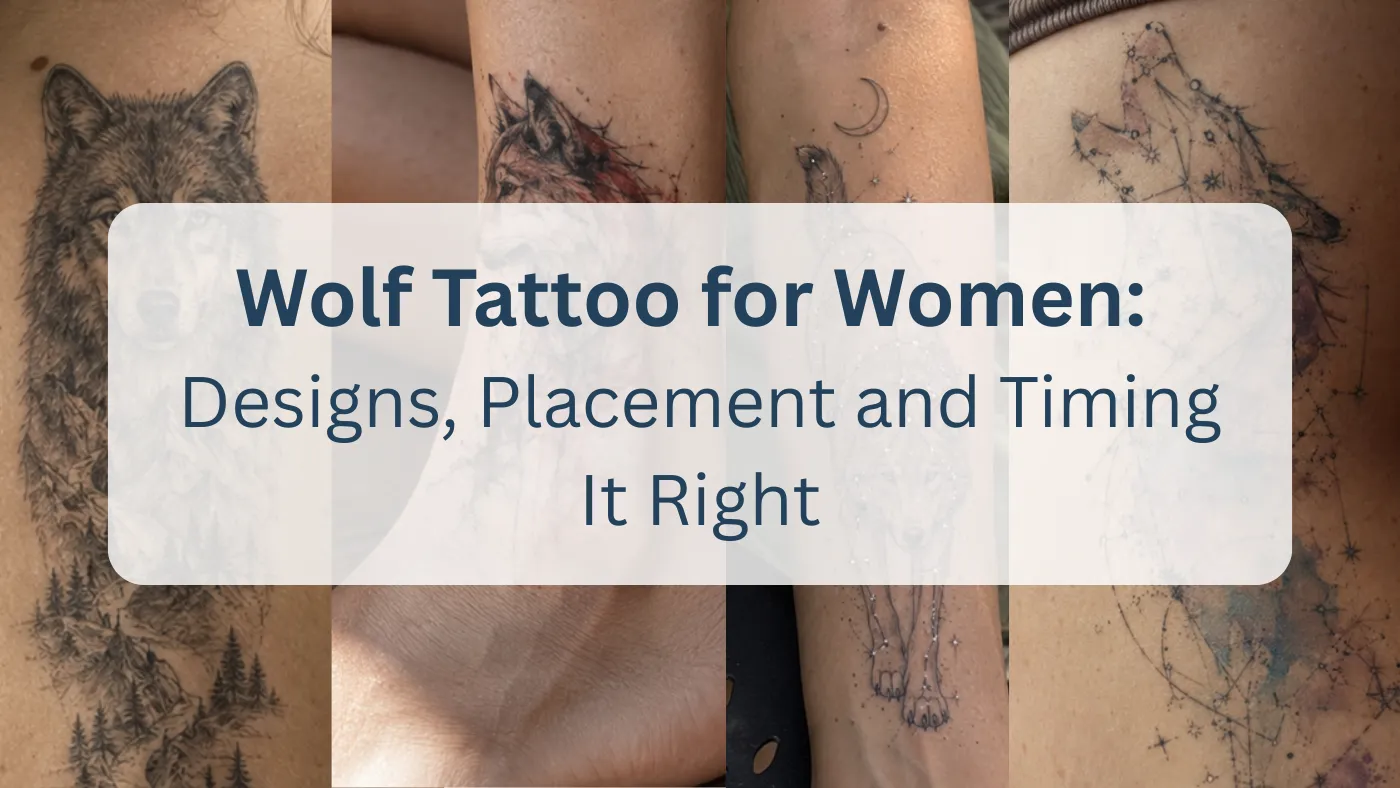
Most articles about wolf tattoos for women treat them like smaller, prettier versions of men's wolf tattoos. Pink flowers added to the side. Watercolor wash around the head. A delicate little wolf on the wrist. That's a lazy framing. The real reason women get wolf tattoos has nothing to do with making them look feminine and everything to do with what the wolf represents to the woman wearing it.
Wolves in mythology aren't soft. They aren't pretty. The she-wolf raised the founders of Rome. The wolf goddesses of Norse and Celtic tradition were guides between worlds, mothers and protectors, hunters and healers. Women have been getting wolf tattoos in those traditions for centuries, long before Instagram decided wolf tattoos for women needed to be paired with peonies.
This guide covers what actually matters when a woman is choosing a wolf tattoo. Which version of the wolf fits you. Where on your body it works best. How to time it around the events that affect your skin, pregnancy, breastfeeding, your cycle, and how to find an artist who treats your tattoo as something serious.
Table of Contents
Why the Wolf Speaks Differently to Women
In nearly every mythology that included wolves, the she-wolf had her own role. Roman myth has the Lupa Capitolina nursing Romulus and Remus. Norse tradition gave us Skadi, the winter goddess, often accompanied by wolves. Greek myth gave us Hekate, walking with wolves at her sides. In Celtic legend, the wolf was a guide between the visible world and the spirit world, a role often held by feminine figures. Indigenous traditions across North America associated the wolf with the moon and with feminine intuition. The pattern is consistent across cultures: the female wolf is protective without being passive, intuitive without being gentle, fierce without being aggressive.
That's the mix women keep returning to in wolf tattoos. The framing in most online articles, "wild yet elegant," "fierce yet feminine," misses the point. A wolf tattoo on a woman isn't about contradiction. It's about layering. A mother who protects without compromising. A survivor who softens without losing edge. A leader who stays connected to her instincts.
The Five Wolf Personalities
Most women's wolf tattoos fall into one of five personality types. The personality decides the design. Read these in order. One should land harder than the others.
1. The Matriarch
Mothers, grandmothers, women who hold the family together. The pack imagery speaks directly to this role. Wolves with cubs, a single wolf protecting a small pack, or a wolf with the names or birth months of children worked into the design. Our deeper guide on wolf pack tattoo meaning covers the symbolism in detail.
Best designs: wolf with cubs, single wolf with banner of names or birth flowers, pack composition in formation. Best placements: outer thigh, ribcage, back of shoulder, between shoulder blades. Size: medium to large.
2. The Survivor
Women who have come through something hard. Postpartum depression, miscarriage, abusive relationships, addiction, serious illness, the loss of a parent or partner. The wolf as survivor symbolism is strong because wolves have been documented surviving in environments that should kill them. The lone wolf tattoo meaning piece breaks down how the symbolism plays out for women specifically.
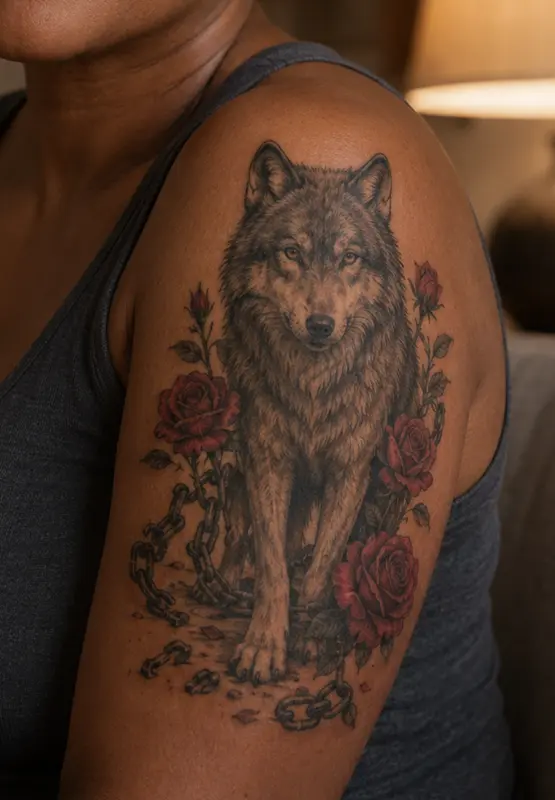
Best designs: lone wolf walking forward through landscape, wolf with roses growing through broken chains, wolf and moon under heavy weather. Best placements: side ribs, upper arm, sternum, spine. Size: medium.
3. The Pathfinder
Women in leadership. Founders, doctors, teachers, mothers running households where they're the planner. Anyone who finds the way for others. The alpha wolf tattoo meaning article covers the modern reading of alpha symbolism, which is less about dominance and more about responsibility. For women, the framing tends to be even more about navigation than command.
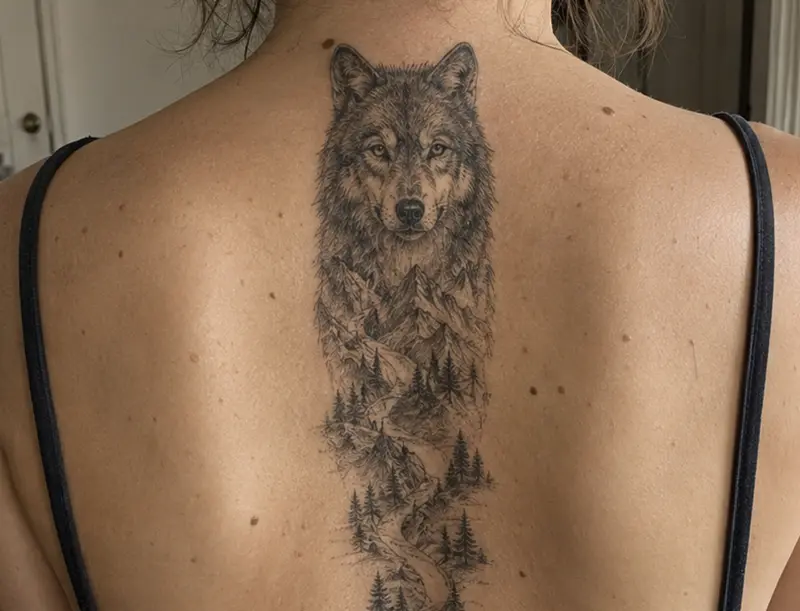
Best designs: wolf standing on a ridge or summit, wolf with a compass or vegvisir, single wolf walking forward through mountains. Best placements: spine, upper back, outer forearm. Size: medium to large.
4. The Wild One
Women who live by their own rules. The travelers, the artists, the ones who never quite settled into the script that was written for them. The wolf as untamed creature speaks directly to this energy. Wild One designs feel forward-moving, free, slightly wild around the edges. Watercolor, splatter effects, and asymmetrical compositions suit this personality more than clean realism.
Best designs: watercolor wolf with color splash, wolf with flowing wind elements, lone wolf in motion, abstract or sketch-style wolf. Best placements: side ribs, hip, calf, inner ankle. Size: medium.

5. The Ancestral
Women with cultural heritage they want to honor. Norse, Celtic, Indigenous, Slavic. Or women drawn to specific mythological figures like Hekate, Skadi or Artemis whose stories involve wolves. The celtic wolf tattoo guide covers knotwork patterns. The viking wolf tattoo guide covers Norse symbolism. Both styles require an artist who knows the visual language, not just one willing to copy a Pinterest image.
Best designs: Celtic knotwork wolf, Norse wolf with runes, wolf with feathers and tribal patterning, wolf with mythological symbols. Best placements: back of shoulder, upper arm, ribcage. Size: medium to large.
Wolf Tattoo Variations Worth Considering
Most articles list 30 wolf head portraits and call it design ideas. The wolf actually works hardest when you combine it with another element that adds a second layer of meaning. Eight combinations especially worth considering for women.
Wolf and Moon
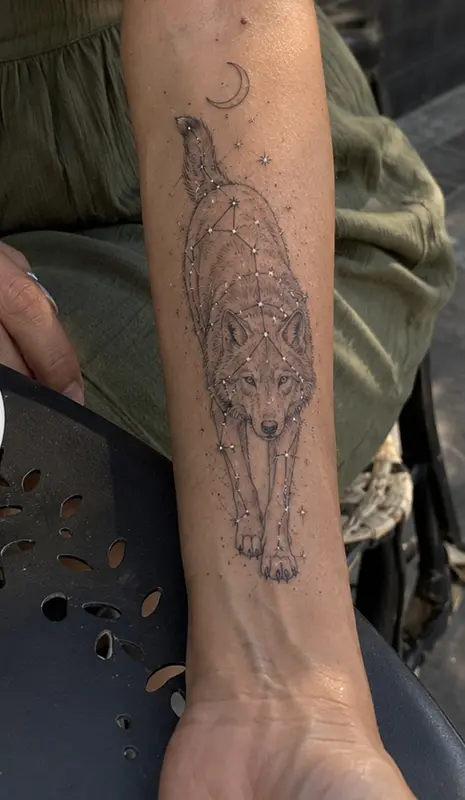
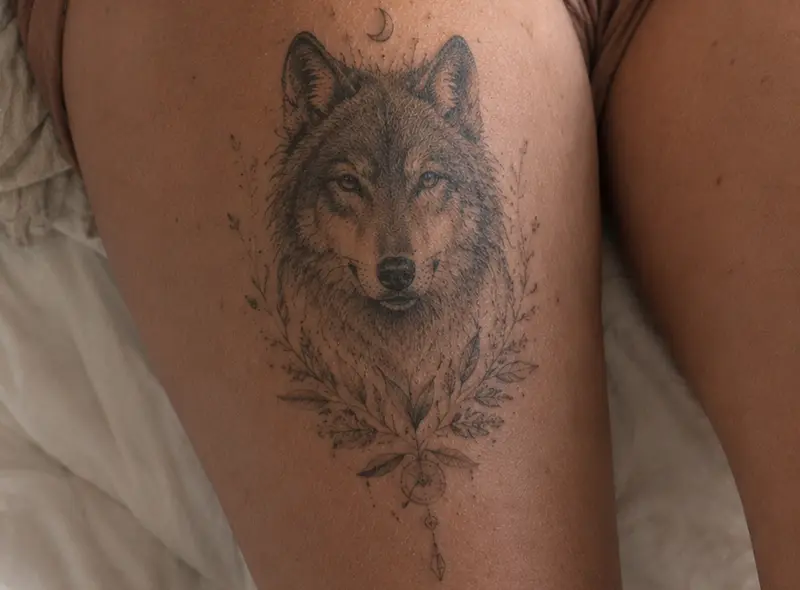
The classic pairing. The wolf has been associated with the moon across most cultures, and the connection between the moon and feminine cycles makes this combination particularly resonant for women. Our wolf and moon tattoo guide goes deeper. The most striking versions include lunar phases trailing along the arm or spine, or a wolf head with a moon halo behind it.
Wolf and Flowers (With Actual Meaning)
This is the design most overused in feminine wolf tattoos, almost always as decoration. To make it meaningful, choose flowers for what they represent rather than what they look pretty next to. Birth flowers for each child. The flower of a deceased loved one's birth month. A flower from your hometown. A flower with specific spiritual meaning. Once the flowers carry meaning, the whole tattoo gains weight.

Wolf and Moth (or Butterfly)
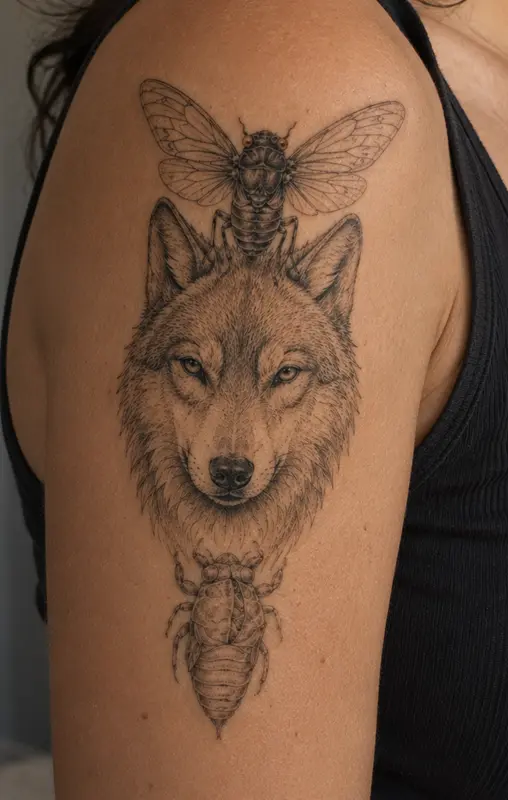
Less common, more interesting. Moths represent transformation, intuition, and the journey through darkness toward light. A luna moth specifically connects back to lunar symbolism. The pairing of a wolf head with a moth above or behind it creates a layered piece about both the wild self and the transforming self. Strong choice for Survivor and Wild One personalities.
Wolf and Feathers / Dreamcatcher
Heritage pairing for women with Indigenous ancestry, or sometimes chosen for the symbolism of protection from negative dreams. Important note: the dreamcatcher specifically is a sacred symbol from Ojibwe tradition. Consider the cultural weight before choosing this combination. If you don't have a personal connection to the tradition, a wolf with feathers, without the dreamcatcher web, carries similar visual feeling without the appropriation concern.
Wolf and Roses
Different from the generic "wolf with flowers" pairing. Roses specifically carry mortality and love symbolism, which pairs hard with the wolf's survivor energy. Red roses for passion, white for memorial, black-shaded roses for grief. The wolf paw tattoo meaning guide also covers paw print plus rose memorial combinations.
Wolf with Names or Birth Dates
Common for Matriarch personality. A single wolf with the names of children, partners or deceased loved ones worked into a banner, the negative space of the design, or running along the bottom. Make sure the typography matches the tattoo's overall mood. A delicate script under a heavy realistic wolf head looks disconnected. Serif or sans block under a clean line wolf works better.
Geometric or Watercolor Polygon Wolf
The geometric wolf is having a strong moment with women specifically. The polygon style strips the wolf down to facets and lines, sometimes with a watercolor splash bleeding behind. Works well for Wild One personality, also for women who prefer clean modern aesthetic over realism. Sizes well from small, 3 inches, to large, 10+ inches.
Wolf Paw Print
Compact, deeply personal. Works at sizes smaller than other wolf designs can sustain. Common meanings include guidance, the path forward, or memorial for someone who guided you. The watercolor brushstroke version of the paw print is the most distinctive form for women, with a soft dark wash suggesting motion or weight.
Where to Put It: A Body Map for Women
Placement decisions for women involve different considerations than for men. Some placements look strong but interfere with everyday clothing. Some change shape over a lifetime. Some hurt much worse than others. Here's the practical breakdown.
Forearm (inner or outer)
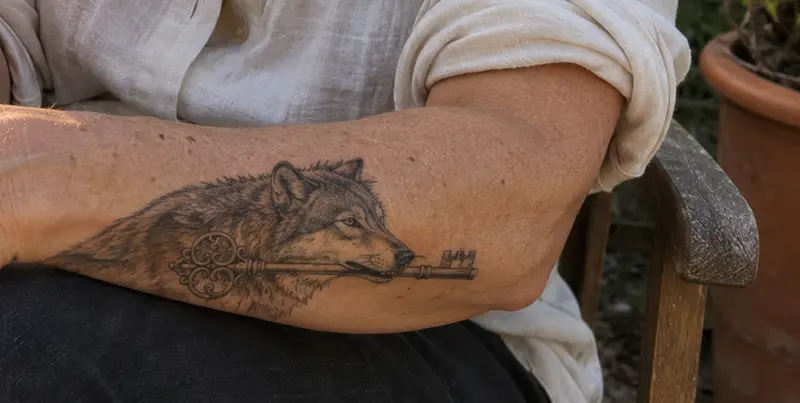
Roughly a third of women's wolf tattoos go on the forearm. Visible, mostly flat, moderate pain, almost every design works there. The wolf forearm tattoo guide covers inner vs outer placement decisions in detail. The inner forearm is the more intimate version. Visible to you when you turn your wrist, but easy to hide.
Side Ribs and Underbust
Excellent placement for medium to large pieces. Hidden under almost any clothing. The space follows the natural curve of the female torso, which suits wolf compositions with vertical flow. Pain is high, the ribs are close to the surface, but the result is one of the most personal placements. Underbust specifically, under the bra band, is even more private.
Important: rib placements can be affected by pregnancy weight gain. If you're planning to have children in the next few years, talk to your artist about that. A ribcage tattoo done at 25 may look slightly different at 35 after a pregnancy. Not ruined, but worth discussing.

Sternum (Center Chest)
The wolf chest tattoo piece covers chest placements in detail. Sternum specifically is underused. The vertical flat surface gives a wolf head excellent symmetry. Pain is high, bone close to surface, but the result has weight that pec-centered chest tattoos can't match. Visible with lower necklines, hidden with everyday clothing.
Outer Thigh and Hip
Big canvas, easy to hide, hurts moderately. Pregnancy considerations apply to the lower hip area specifically, where stretch marks are common. Outer thigh stays mostly stable through pregnancy and weight changes. Good for Matriarch designs because there's room for the wolf plus supporting elements like cubs or flowers.
Spine
Long vertical canvas. Suits a wolf running down the back, or a wolf head at the top with the body fading down toward the mid-back. Less common than other placements, which is why it stands out. Pain is moderate to high depending on how close the design runs to the actual vertebrae.
Inner Ankle, Behind Ear, Inner Wrist
All three suit small or single-line wolf designs. The small wolf tattoo guide goes deeper into what works at compact sizes. These three placements are especially common as first tattoos and as second pieces added to existing tattoos.
Back of Shoulder / Shoulder Blade
Hidden 90% of the time, visible from specific angles, when wearing a backless or low-back top. Smooth, mostly-flat surface. Lower pain than ribs or sternum. Great placement for Ancestral or Pathfinder designs that include nature elements.
Where to Avoid or Reconsider
Stomach. Pregnancy and weight changes affect this placement more than any other on the female body. Stretching can distort the design significantly. If you're young or planning children, hold off.
Breast itself, not sternum, the actual breast tissue. Pregnancy, breastfeeding and weight changes all alter the size and shape of the breast. A tattoo placed here can warp. The sternum is the safer alternative for a wolf in this general area.
Top of foot. Heals badly because of constant shoe friction. Often needs touch-ups. If you want a foot wolf, the inner ankle is the better placement.
Timing It Right: Pregnancy, Breastfeeding and Your Cycle
This is the section most wolf tattoos for women articles skip entirely. The timing of when you get a tattoo matters for women in ways it doesn't for men, and the choices have practical consequences.
During Pregnancy
Most dermatologists and obstetricians advise against getting a new tattoo during pregnancy. According to WebMD's overview of tattoos during pregnancy, the primary concerns are infection risk, which can affect the pregnancy more severely than usual, and the lack of research on how tattoo ink interacts with pregnancy physiology. Existing tattoos are fine. New ones are usually advised to wait.
Practical advice: if you're trying to conceive, finish any tattoo plans before you start trying, or accept that you may be waiting 12+ months.
While Breastfeeding
Authorities are more cautious here than the general public realizes. The NCBI LactMed database, which is the National Library of Medicine's reference for medication and substance safety during lactation, notes that no data exists on the safety of tattooing during breastfeeding. The theoretical concerns relate to potential transmission of ink pigments or infection to the infant.
The Healthline guide on breastfeeding and tattoos notes that tattoo ink molecules are large and unlikely to pass into breastmilk, and that no negative effects on babies have been reported when a breastfeeding mother gets a tattoo. The bigger concern is infection at the tattoo site, which can be transmitted to the baby. Most professional guidance leans toward waiting until after breastfeeding ends.
Practical advice: if you're breastfeeding and considering a wolf tattoo, the safer choice is to wait. If you proceed anyway, choose a studio with strict sterile practices and verify the artist's licensing.
Around Your Cycle
Less talked about, but worth knowing. Pain sensitivity tends to increase in the days before and during your period due to hormonal fluctuations. Some women report tattoos hurting noticeably more during these phases. The sweet spot for scheduling, if pain matters to you, is the week after your period ends. Estrogen is higher, pain tolerance is better, and you're less likely to feel bloated during a long session.
Avoid scheduling a tattoo during PMS, during your period itself if you're sensitive, or right around ovulation if you have cyclical symptoms then. Your artist won't mind a reschedule for this reason. Tell them what's up.
After Childbirth, Before the Next Major Life Phase
If you've had a baby and you're not breastfeeding, or you've weaned, most dermatologists recommend waiting 3 to 6 months postpartum for your body to recover before getting tattooed. The Cleveland Clinic's tattoo aftercare guidelines note that healing takes 2 to 3 weeks at the surface but several months at the deeper layers, and that healing is slower when the body is already doing a lot of recovery work.
Style Choices That Match Different Energies
The right style depends on the personality and the energy of the piece you want. Here are the styles that work hardest for women, by mood.
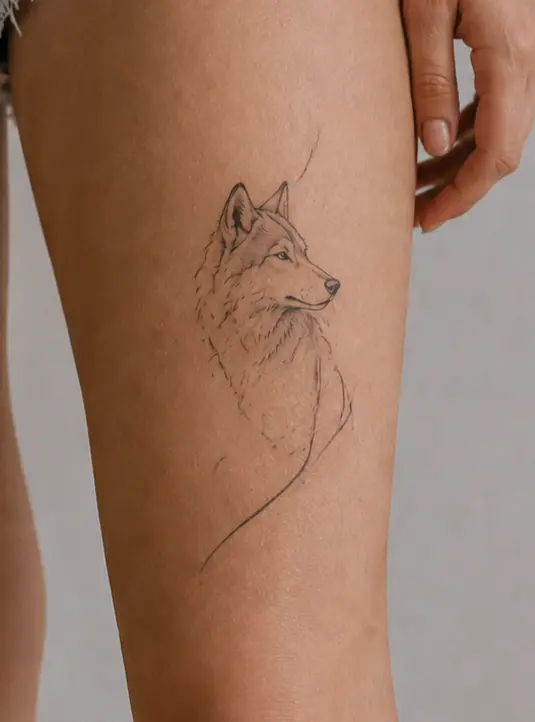
For intuition and intimacy, watercolor or single-line minimalist styles. Soft, personal, more contemplative. For groundedness and strength, realistic wolf tattoo or traditional black and grey. The wolf head tattoo guide covers portrait quality in detail.
For heritage and depth, Celtic knotwork or Norse runic styles. For wildness and motion, tribal wolf tattoo or sketch or abstract styles. For modern aesthetic, geometric polygon or fine line work.
Watercolor polygon hybrids, geometric outlines with watercolor splashes underneath, are particularly popular with women right now and look distinctive next to standard wolf head portraits. The combination reads as both structured and emotional, which suits many of the wolf personality types in this guide.
What to Avoid
Five mistakes women make with wolf tattoos more often than anything else.
Choosing decoration over meaning. The most common mistake is picking a wolf with flowers because it looks pretty in Pinterest screenshots. If the flowers don't mean something specific to you, birth flowers, memorial, hometown, spiritual significance, they'll feel hollow in five years.
Going too small for the detail you want. A 1.5-inch realistic wolf will blur within two years. If you want detail, commit to a size that supports it, at least 4 to 5 inches. If you want small, choose minimalist, single-line, or silhouette designs that hold up at compact sizes.
Placing it on tissue that will change. The breast itself, the lower stomach, and the lower hip are the placements most affected by pregnancy and weight fluctuation. If you're young or planning children, those placements come with risk.
Picking the artist by Instagram aesthetic. A beautiful Instagram feed isn't the same as great healed work. Ask to see healed photos of pieces over 2+ years old. If the artist can't show you that, find one who can.
Trying to make the design "feminine." If you start with the question "how do I make this wolf look feminine," you'll likely end up adding flowers and softening edges in ways that don't serve the tattoo. Start with the question "what does this wolf mean to me" and the design will become the right one for your body without forcing it.
Real Cost Ranges in 2026
Average rates for solid mid-tier artists in the US, UK and Australia. Top-name artists in major cities run 30 to 50% higher. Smaller cities run 20 to 30% lower.
| Tattoo | Cost Range | Sessions | Total Time |
|---|---|---|---|
| Small wolf (silhouette, fine line) | $80 to $200 | 1 | 30 min to 1 hr |
| Inner wrist / behind ear / ankle | $100 to $250 | 1 | 1 to 2 hrs |
| Medium forearm or upper arm | $300 to $800 | 1 | 3 to 5 hrs |
| Ribcage / side body | $500 to $1,200 | 1 to 2 | 4 to 7 hrs |
| Outer thigh (medium) | $400 to $900 | 1 | 3 to 5 hrs |
| Sternum or chest piece | $500 to $1,200 | 1 to 2 | 4 to 7 hrs |
| Back / shoulder blade | $500 to $1,500 | 1 to 2 | 5 to 8 hrs |
| Half sleeve | $1,200 to $2,800 | 2 to 4 | 8 to 20 hrs |
A cost note specific to women's placements. The ribcage, sternum and back tend to cost slightly more than equivalent-sized pieces on the forearm or thigh because they take longer, more pain breaks, more careful linework on curved surfaces. Budget accordingly.
Aftercare for the Placements Women Pick Most
Aftercare is broadly the same for everyone, keep it clean, keep it moisturized, keep it out of the sun for 4 to 6 weeks, but a few placements common with women have specific considerations.
Ribcage and sternum. Tight bras and bra bands rub these areas constantly. For the first 2 to 3 weeks of healing, switch to a soft bralette or go bra-free at home. Underwire and tight bands can cause scabbing to come off prematurely, which is the main risk factor for blowouts and uneven healing.
Outer thigh and hip. Tight jeans and leggings rub these placements. Wear loose pants or dresses for the first 2 weeks. Synthetic fabric is worse than cotton.
Behind the ear. Long hair tangles in the healing scabs constantly. Either keep hair up for 2 weeks or accept some itching and possible scab-pulling.
Inner wrist and inner ankle. Watches, bracelets, and shoes irritate these areas. Skip wearing them for 2 weeks or pad the area with breathable bandage when you need to wear them, work, exercise.
Quick Answers
Q: What is the most popular wolf tattoo design for women?
Ans. A medium-sized black and grey realistic wolf on the forearm or side ribs is the most common combination. Geometric polygon wolves with watercolor splashes are the second most popular style, growing fastest. Wolf with intentional flowers, birth flowers, memorial flowers, is the third most common combination.
Q: Can I get a wolf tattoo while breastfeeding?
Ans. Most medical authorities including the NCBI LactMed database recommend waiting until after breastfeeding ends. The ink molecules are too large to pass into breastmilk, but the infection risk at the tattoo site is the main concern, which can be transmitted to the baby. If you proceed, choose a studio with strict sterile practices.
Q: Where is the best placement for a woman's first wolf tattoo?
Ans. Inner forearm, outer upper arm, or outer thigh are the safest first placements. All three handle most designs, hurt at moderate levels, and are easy to cover for work. The wrist and behind-the-ear are good options for smaller designs. Avoid the stomach, breast, and top of the foot for first tattoos.
Q: How much does a wolf tattoo for a woman cost?
Ans. Small designs run $80 to $250. Medium pieces on the forearm or thigh run $300 to $900. Ribcage, sternum and back pieces run $500 to $1,500. Half sleeves run $1,200 to $2,800. The artist's reputation and your city affect the rate more than the design itself.
Q: Will my wolf tattoo look weird after pregnancy?
Ans. Depends on placement. Forearm, calf, shoulder, behind ear, and back of upper arm tattoos are mostly unaffected. Lower stomach, breast, hip and lower back tattoos can stretch or distort. Outer thigh and outer ribcage usually hold up well. If you're planning to have children, avoid placements on tissue that will stretch substantially.
Q: Should I get a tattoo during my period?
Ans. You can, but it may hurt more. Pain sensitivity tends to increase before and during menstruation due to hormonal changes. The week after your period ends is the sweet spot for pain tolerance. If pain matters to you and your cycle is regular, schedule accordingly.
Q: How do I make my wolf tattoo not look generic?
Ans. Don't bring a Pinterest screenshot. Bring references for elements you like, the mood, the level of detail, the style, then let the artist design something specifically for your body and your meaning. The wolf with intentional flowers approach, birth flowers, memorial flowers, hometown flowers, is one of the easiest ways to add personal meaning that nobody else has.
Final Word: The Wolf You Choose Is the Woman You're Naming
The mistake women make with wolf tattoos isn't picking the wrong style or the wrong placement. It's starting with the question "how do I make this wolf look feminine." That question leads to decoration. Flowers added because they're pretty. Soft lines added because they're soft.
Start with a different question. Which version of the wolf is mine. Matriarch, Survivor, Pathfinder, Wild One, Ancestral. Once you know which one is yours, the design follows naturally. The flowers, if you include them, carry meaning. The placement makes sense for your body and your life. The style matches your energy. The tattoo becomes a statement about the woman you already are or the one you're becoming.
After that, find an artist whose healed work proves they can do the version you want. Time it around the events in your life, pregnancy, breastfeeding, your cycle, so your skin is ready. Take care of it for six weeks. And then forget about it. For more on the other half of the wolf-tattoo population, our companion guide on wolf tattoos for men covers the male perspective. There's more crossover than people assume.

