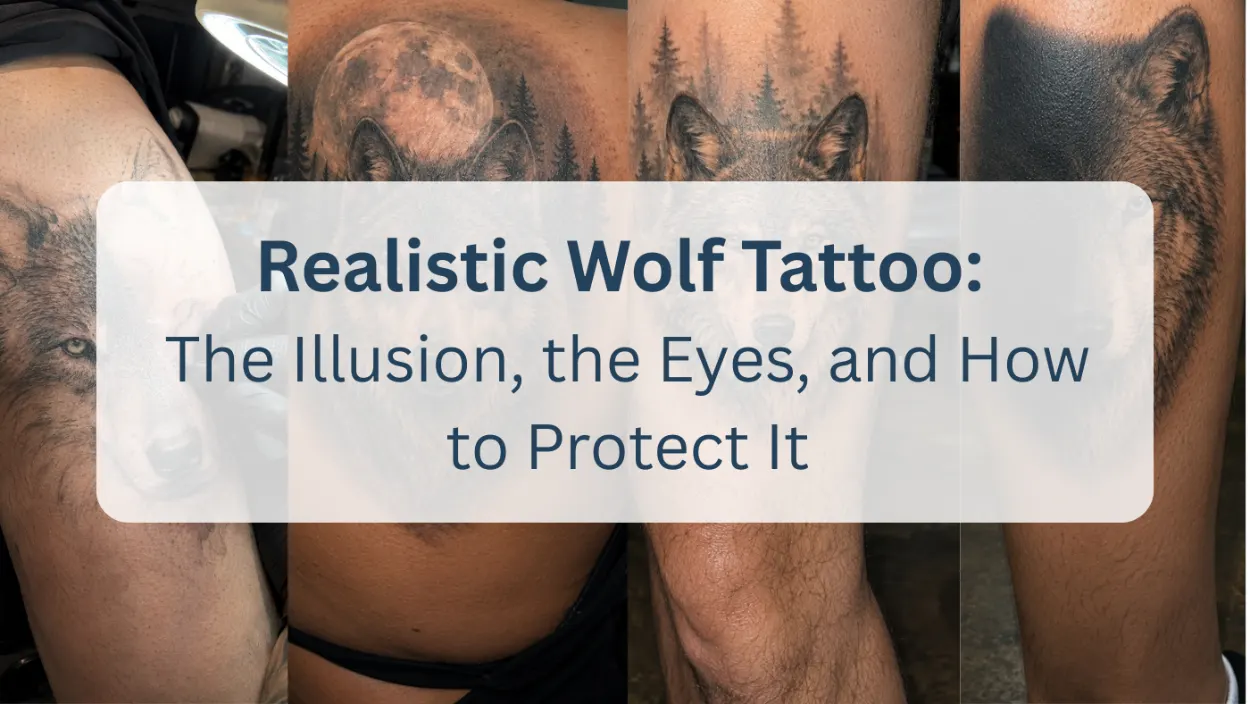
A realistic wolf tattoo is not really a style. It is an illusion. It is a flat arrangement of grey and black, or color, on a curved moving surface, engineered to trick the eye into seeing a living animal that is not there. When it works, people do a small double take. When it fails, it fails loudly, because everyone knows what a wolf is supposed to look like and the brain notices the moment something is off.
That is the whole truth of this style, and almost nobody writing about it says so. The galleries show you 50 stunning photos taken the week the tattoo was done and let you assume yours will look like that forever. This guide is about the parts that decide whether it actually does: what makes the illusion convincing, why the eyes carry all of it, who can pull it off, and the maintenance reality the photo galleries quietly skip.
It sits in the styles section of the broader wolf tattoo designs pillar. If you have not settled on what the wolf means to you yet, the wolf tattoo meaning guide is the right first stop, because realism rewards a clear intention and punishes a vague one.
Table of Contents
What Realism Actually Is (and What It Is Not)
Realism, sometimes called photorealism, aims to reproduce a wolf the way a camera would see it: continuous tone, real anatomy, believable light, and crucially no outline. The form is built entirely from value and contrast. That single fact is what separates it from everything else. A traditional wolf tattoo is built on a bold outline and flat color and is engineered to survive decades. Realism is the opposite philosophy: it removes the outline to chase depth, which makes it far more striking and far more fragile at the same time. Neo-traditional wolf tattoo sits between the two, keeping an outline while adding dimension. Understanding that spectrum matters, because choosing realism means choosing the most demanding point on it.
Two more distinctions worth knowing. Hyperrealism (or micro-realism) pushes detail even further, often small and astonishingly precise, with the same fragility amplified. And realism is not the same as a wolf portrait in general; the broader wolf head tattoo guide covers portraits across styles, while this article is specifically about the photographic treatment.
The Illusion Lives or Dies in the Eyes
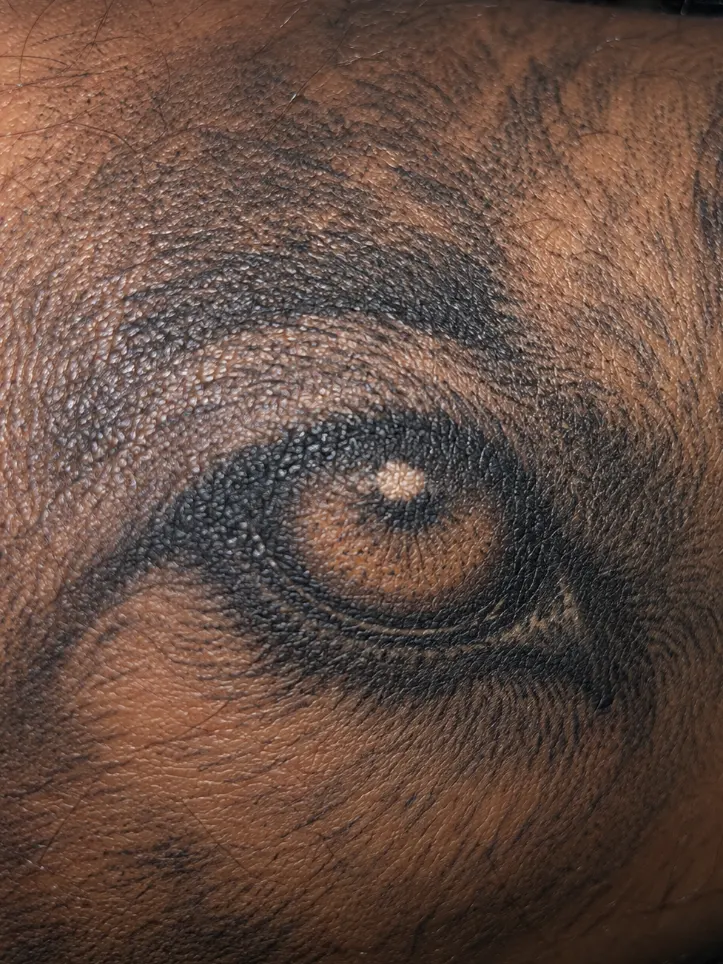
If you remember one thing, remember this. A realistic wolf with perfect fur and dead eyes is a taxidermy mount. A realistic wolf with slightly imperfect fur and genuinely alive eyes is a living animal. The eyes are not a detail. They are the entire illusion, and a good artist spends a disproportionate amount of the session on a surprisingly small area.
Three things make a wolf eye read as alive: the catchlight (the tiny bright reflection that says light is hitting a wet, round surface), the wetness along the lower lid and inner corner, and focus, meaning the eye is clearly aimed somewhere rather than staring blankly. Get those three right and the rest of the face can be merely good. Get them wrong and no amount of fur detail rescues it. Because the eyes carry so much weight, this is also where symbolism concentrates, and the wolf eyes tattoo meaning guide is worth reading before you decide whether your wolf should look at the viewer, away, or through them.
The Four Things That Make a Wolf Look Alive
Beyond the eyes, four things separate a convincing realistic wolf from an expensive one that looks flat. Hand this list to your artist as the brief.
1. Believable Single-Source Light
Real animals are lit by one dominant light. If the wolf's face says the light is coming from the upper left but the chest is lit from the right, the brain rejects it instantly even if it cannot say why. A strong realistic wolf has one consistent light logic, and good artists will tell you where the light is before they start. This is also why moonlit and rim-lit wolves work so well: a single clear source.
2. Fur With Direction and Depth, Not Texture for Its Own Sake
Fur is not random scribble. It grows in mapped directions, layers over itself, and changes density around the muzzle, ears and ruff. Convincing fur follows that map and uses dark underlayers to create depth, so the coat looks like it has volume rather than being painted on flat. Beginner realism gives you even, directionless texture. It reads as carpet, not animal.
3. Contrast Range, Especially the Deep Blacks
The illusion of depth comes from a full value range, and specifically from genuinely dark darks. Timid realism that never commits to true black stays grey and flat forever and fades to nothing faster. The deepest shadows in the ears, the nostrils and under the jaw are what push the rest of the face forward. This is a skill and a nerve issue as much as an art one.
4. A Resolved Edge: Where Does the Wolf End?
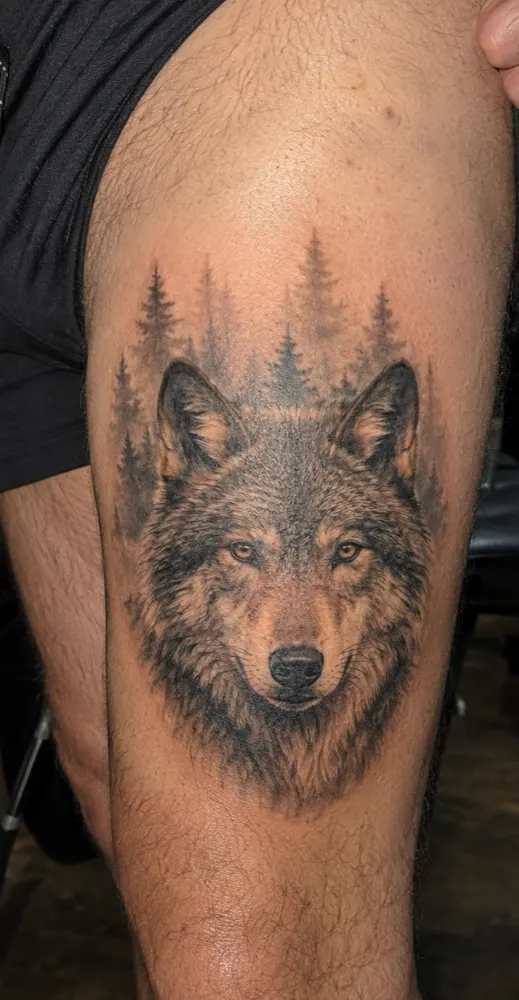
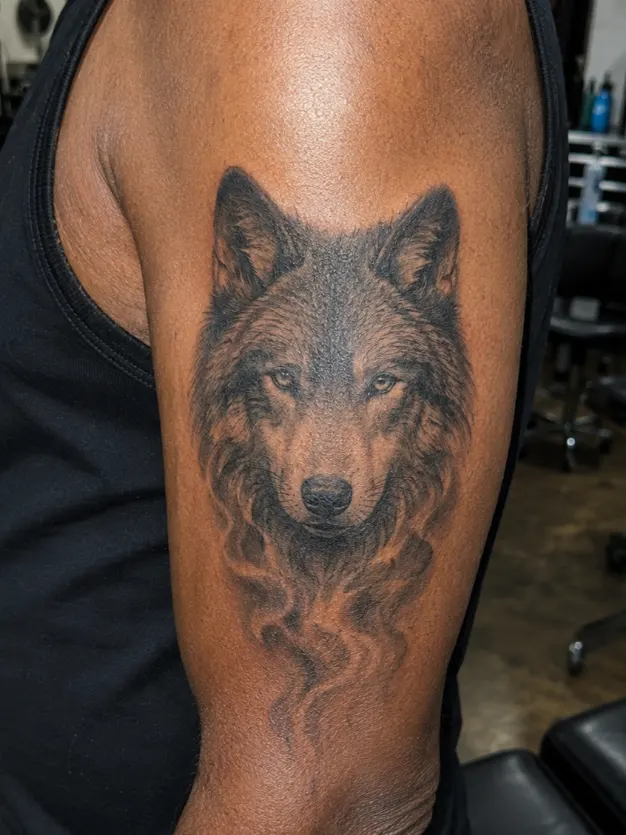
Because there is no outline, the artist has to solve how the wolf meets bare skin. The strong solutions are a soft vignette, a deliberate hard photographic crop, or a fade into smoke, mist or forest. The weak solution is letting the fur just stop in midair, which instantly exposes the tattoo as a tattoo. How the wolf ends is as important as how it looks, and it should be designed, not improvised in the chair.
Black and Grey or Color?
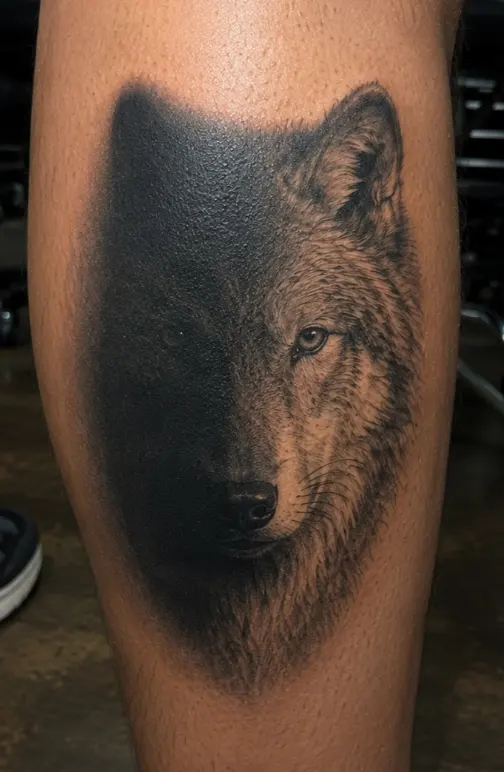
This is the real decision in realism, more than the pose. Black-and-grey realism is the more durable and the more forgiving of the two. It has fewer ways to go wrong, ages more gracefully, and reads as timeless. Color realism hits harder, especially with amber eyes and a warm coat, but it carries more risk: color fades faster and unevenly, and some pigments behave very differently on different skin tones.
On medium-to-dark skin, color realism is harder and a good artist will say so and adjust saturation and value accordingly. If an artist insists on standard color realism for darker skin without discussing it, that is a warning sign. Black-and-grey realism, by contrast, works beautifully on every skin tone, which is part of why it is the safer default for a once-in-a-lifetime piece.

The Artist Is 90 Percent of the Result
No style depends on the individual artist as completely as realism. A great traditional artist and an average traditional artist produce a small quality gap. A great realism artist and an average one produce a different tattoo entirely. A mediocre realistic wolf is worse than a great traditional wolf, full stop, because realism has nowhere to hide.
Vet ruthlessly. Look for a deep body of realism work, not a few realistic pieces between other styles. Look for healed photos several years old, because fresh realism always looks good and only healed work tells the truth about contrast retention. Look hardest at the eyes in their portfolio: if their animals' eyes look alive in healed photos, they can do yours. If every example is a fresh photo and the eyes look flat, keep searching. The right artist for this style is often worth a long drive and a long waitlist.
Size and Placement: Detail Needs Room and Shelter
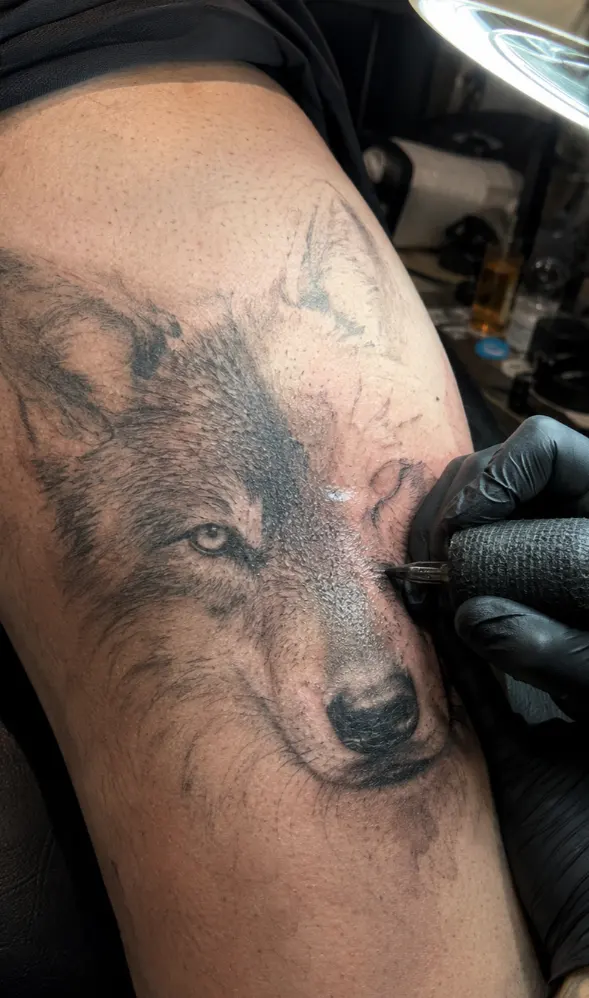
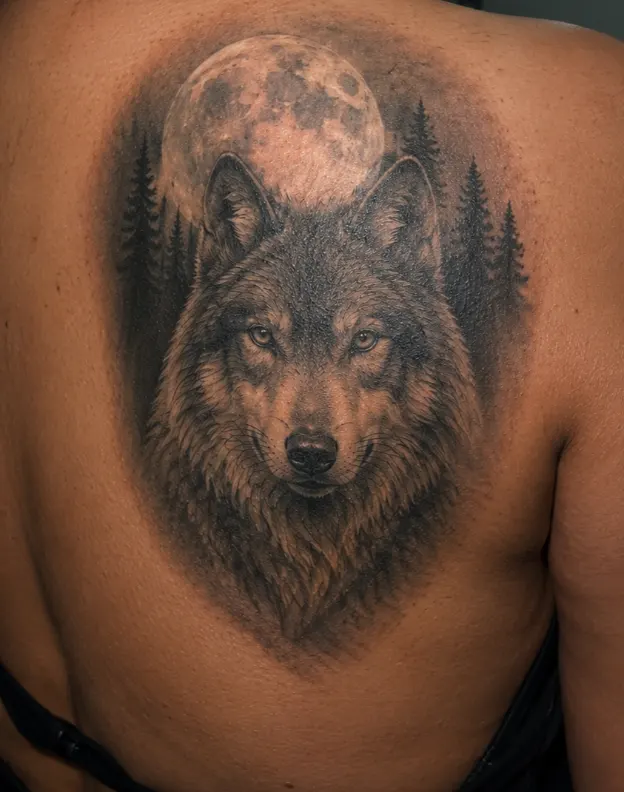
Realism has a higher minimum size than any other wolf style, because detail that cannot be resolved cleanly will blur into a grey smudge within a few years as ink spreads. A realistic wolf head wants real estate: think palm-sized at the absolute minimum, and comfortably larger for a full face with a background. The full body-area logic is in the wolf tattoo placements pillar, but realism specifically wants flat, broad, low-stretch, low-friction, low-sun canvases. The wolf back tattoo placement is arguably realism's ideal home: a large flat sheltered canvas that holds detail for decades. The wolf forearm tattoo is the popular choice and works well at size, with the honest caveat that forearms see sun and fade faster. And if you were picturing something tiny and intricate, read the small wolf tattoo guide first, because small plus realism plus heavy detail is the combination most likely to disappoint you in five years.
The Maintenance Truth Nobody Tells You
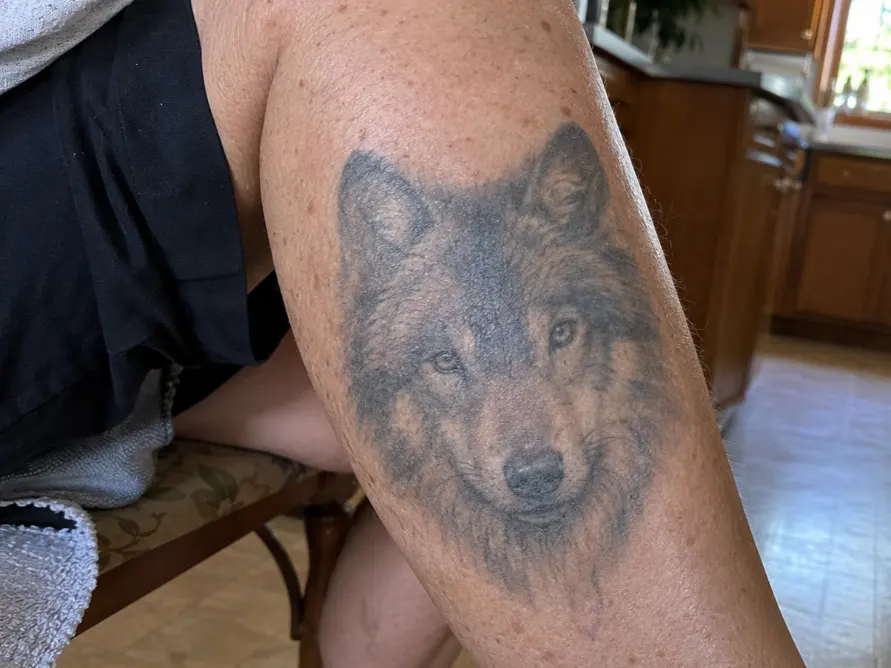
Here is the honest counterweight to every gorgeous gallery photo. Realism is the most impressive wolf style at year one and the most fragile at year fifteen. That is not a flaw to hide from, it is a fact to plan around. Fine, low-contrast detail is exactly what degrades first as ink spreads and the body slowly reworks the skin. A PMC review on tattoo sun exposure links consistent UV directly to premature fading and line breakdown, and realism has no bold lines to fall back on when that happens.
The defense is threefold. First, it has to heal perfectly: the Cleveland Clinic's tattoo aftercare guidance notes the surface heals in two to three weeks while deeper layers settle for months, and any patchy healing in a realistic piece shows permanently. Follow the Healthline tattoo aftercare routine to the letter, because realism is the least forgiving style of a sloppy heal. Second, sun is the single biggest long-term enemy; the American Academy of Dermatology's tattoo guidance stresses sun protection as the main lever for keeping ink sharp, and for realism that means committed SPF on the piece for life, not occasionally. Third, accept that a great realistic wolf may want a refresh somewhere around the ten to fifteen year mark. Budget for it emotionally and financially now. A wolf with deep cultural weight, the kind catalogued in the Wikipedia overview of wolves in folklore and mythology, is worth maintaining; treat the touch-up as part of the deal, not a failure.
What Kills the Illusion
Five mistakes ruin more realistic wolves than anything else. Every one is avoidable.
Going too small. Heavy detail at small size is a guaranteed grey smudge within years. If you want small, realism is the wrong style; choose something built for the scale.
The wrong artist. The single biggest factor. A realism wolf from a non-specialist is the most common way this goes wrong and the hardest to fix.
Dead eyes. Covered above and worth repeating, because it is the failure people feel without being able to name. If the portfolio's eyes are flat, the answer is not this artist.
Fighting the light or the edge. Inconsistent lighting and fur that just stops in midair both break the illusion no matter how good the rest is. These are design decisions, not chair improvisations.
Pretending it is permanent in the gallery sense. Skipping sun protection and refusing to plan for a refresh is choosing to watch the illusion die early. This applies whether the piece comes from the ideas in the wolf tattoos for men guide or the wolf tattoos for women guide. The wolf changes; the physics of realism does not.
Cost and Time in 2026
Realism is priced on time and skill, and it is time-intensive. These are mid-tier realism specialist rates in the US, UK and Australia. In-demand realism artists run well above this and are worth it for this style specifically. Budgeting low is the false economy that produces the disappointing examples.
| Realistic wolf piece | Cost range | Sessions | Total time |
|---|---|---|---|
| Small B&G wolf head (palm-sized) | $300 to $700 | 1 | 3 to 5 hrs |
| Medium B&G wolf portrait | $600 to $1,300 | 1 to 2 | 5 to 8 hrs |
| Medium color wolf portrait | $800 to $1,600 | 2 | 6 to 10 hrs |
| Wolf with moon / forest scene | $1,000 to $2,200 | 2 to 3 | 8 to 14 hrs |
| Large back or thigh realism wolf | $1,500 to $3,500 | 2 to 4 | 12 to 20 hrs |
| Realism half sleeve | $2,000 to $4,500 | 3 to 5 | 15 to 25 hrs |
| Realism full sleeve | $3,500 to $7,000+ | 5 to 9 | 25 to 45+ hrs |
| Touch-up / refresh (per session) | $150 to $500 | 1 | 1 to 3 hrs |

Quick Answers
Q: What makes a realistic wolf tattoo look real?
A: The eyes, above everything: a crisp catchlight, visible wetness, and clear focus. After that, a single believable light source, fur with mapped direction and depth, a full contrast range with genuinely deep blacks, and a resolved edge where the wolf meets bare skin. Fur detail alone does not do it; dead eyes kill it regardless.
Q: Do realistic wolf tattoos age well?
A: They are the most impressive style fresh and the most fragile long term. Fine low-contrast detail blurs first as ink spreads, and there is no bold outline to fall back on. They age acceptably with strict sun protection and a likely refresh around 10 to 15 years. Black and grey ages better than color.
Q: Is black and grey or color better for a realistic wolf?
A: Black and grey is more durable, more forgiving, works on every skin tone, and reads as timeless. Color hits harder but fades faster and unevenly and is trickier on darker skin. For a once-in-a-lifetime piece, black and grey is the safer choice; color is the bolder one.
Q: How big does a realistic wolf tattoo need to be?
A: Bigger than most people expect. A realistic wolf head wants to be palm-sized at the absolute minimum and comfortably larger with a background. Heavy detail at small size becomes a grey smudge within a few years. If you want small, realism is the wrong style for it.
Q: Where is the best placement for a realistic wolf tattoo?
A: Flat, broad, low-stretch, low-friction, low-sun areas. The upper back is arguably ideal: a large sheltered canvas that holds detail for decades. The thigh is also excellent. The forearm is popular and works at size but sees sun and fades faster, so commit to sunscreen.
Q: Why is my realistic wolf tattoo so expensive?
A: Realism is priced on time and rare skill. A medium portrait is 5 to 10 hours; a large piece is 12 to 20 or more. A genuine realism specialist costs more than a generalist and is the single biggest factor in whether the tattoo succeeds. Budgeting low is the usual cause of disappointing results.
Q: How do I choose a realistic wolf tattoo artist?
A: Look for a deep body of realism work rather than occasional realistic pieces, healed photos several years old (not just fresh ones), and animals whose eyes look alive in those healed photos. If the eyes look flat or every example is fresh, keep looking even if it means traveling.
Final Word: Buy the Illusion With Your Eyes Open
A realistic wolf is the closest tattooing comes to magic, and the closest it comes to a high-wire act. The illusion is real, but it is fragile, and it depends almost entirely on three decisions you make before the needle starts: the right artist, enough size on the right canvas, and an honest acceptance of what the years will do. Get the eyes right and protect them from the sun, and you get a wolf that looks back at people for a long time.
Go in clear-eyed and it is one of the most rewarding tattoos a person can wear. Go in believing the gallery photo is the forever state and you will be let down. The choice is not whether realism is worth it. It is whether you will treat it like the living thing it is pretending to be, and maintain it accordingly. From here, the wolf tattoo designs pillar lets you weigh realism against every other style side by side, and the wider wolf tattoo hub ties the whole decision together.