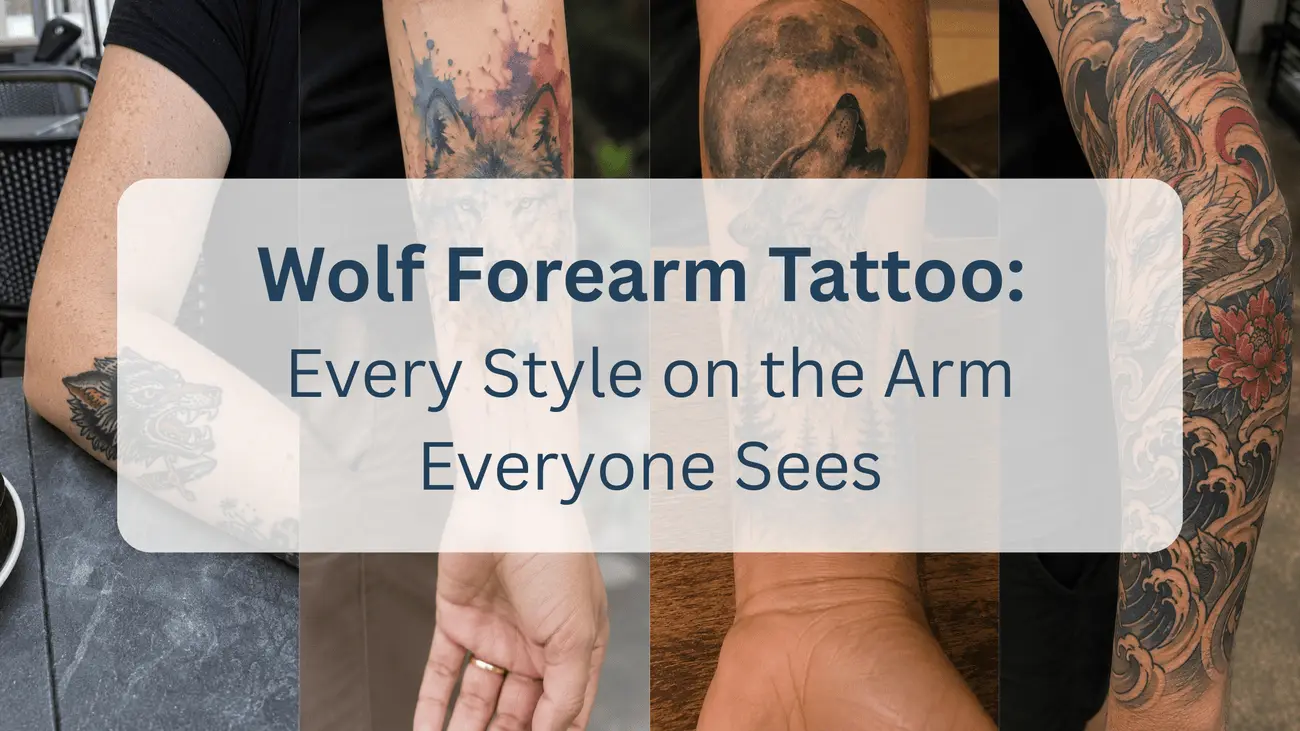
Roll up your sleeve and look at the inside of your forearm. Now turn your wrist over and look at the outside. You just looked at two of the most-tattooed surfaces on the human body, and they are not the same canvas. One faces you. One faces the world. Almost half of all wolf tattoos end up somewhere on this stretch of arm between the wrist and the elbow, and there is a good reason for that, and a catch that comes with it.
The reason is that the forearm just works. It is flat enough, long enough and low enough on the pain scale that almost any wolf you can dream up will sit there cleanly. The catch is that it is the one piece of ink you and everyone you meet will see every single day, in daylight, for the rest of your life. That second fact shapes everything that follows, from which style ages well to which way the wolf should face.
Rather than rank body parts, this guide walks through the wolf itself, style by style, and shows how each one actually wears on a forearm. It sits inside the broader wolf tattoo placements pillar, which weighs the arm against every other spot on the body. If you have not pinned down a style yet, the wolf tattoo designs pillar is the place to browse the full range first, then come back here to see how your favorite lives on the arm.
A quick orientation before the styles, because the arm has two faces and a few moods. The outer forearm, the side on top when your arm hangs down, is the public face: flat, the most visible, and the most comfortable to tattoo. The inner forearm is the private face, softer and a little more tender, seen properly only when you turn your wrist or reach out your hand. The few inches near the wrist sting more than the rest as the skin thins over bone, and the crook of the elbow is sharper still. And then there is the option of using the whole circumference, wrist to elbow, which stops being a single tattoo and becomes the opening chapter of a wolf sleeve tattoo. Keep that simple map in mind. Every style below leans toward one part of it.
Table of Contents
Traditional: the Forearm's Oldest Friend
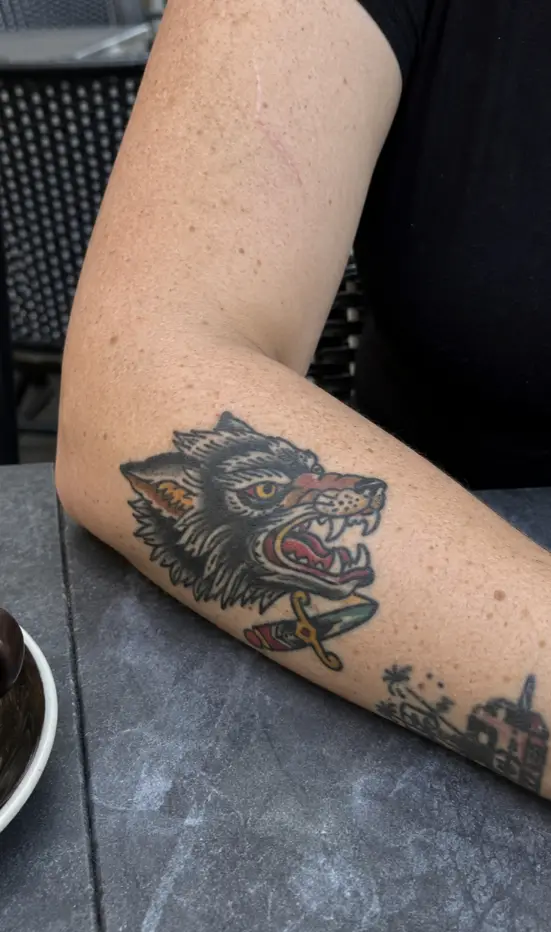
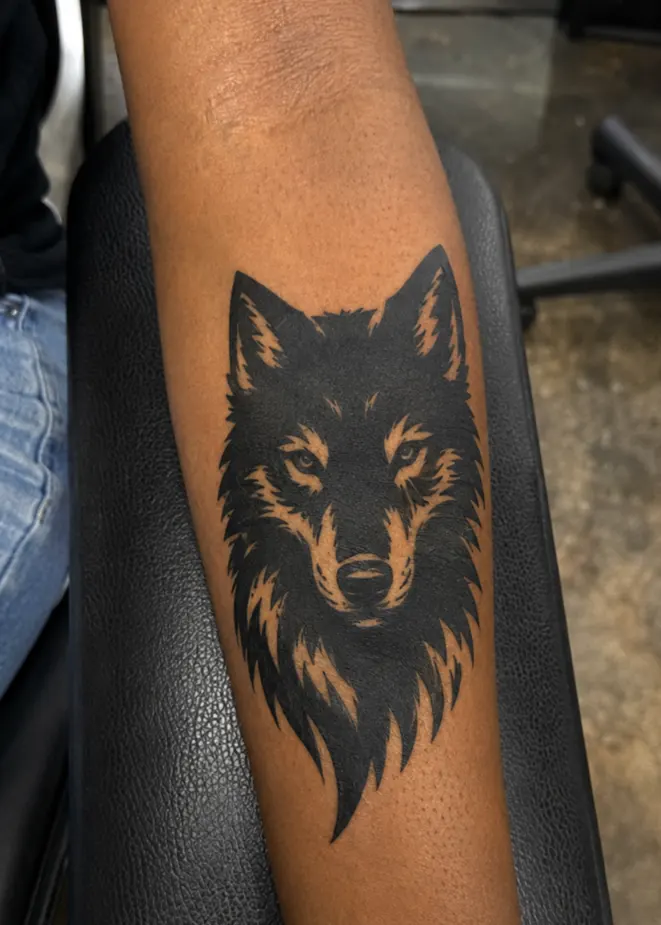
Start here because history did. The forearm was the classic home of old-school tattooing long before wolves were fashionable, and the match still holds. A traditional wolf tattoo leans on heavy black outlines, a small bright palette and bold shapes, and that boldness is exactly what the forearm needs, because this is a placement that lives in sunlight. Fine detail fades out there. Thick lines and solid black do not, or at least not for a very long time. If you want one wolf that will still read clearly in your sixties with the least fuss, a bold traditional piece on the outer forearm is the safest bet on the board, which is why it is the featured image at the top of this guide.
Tribal and Blackwork: Pattern That Follows the Arm
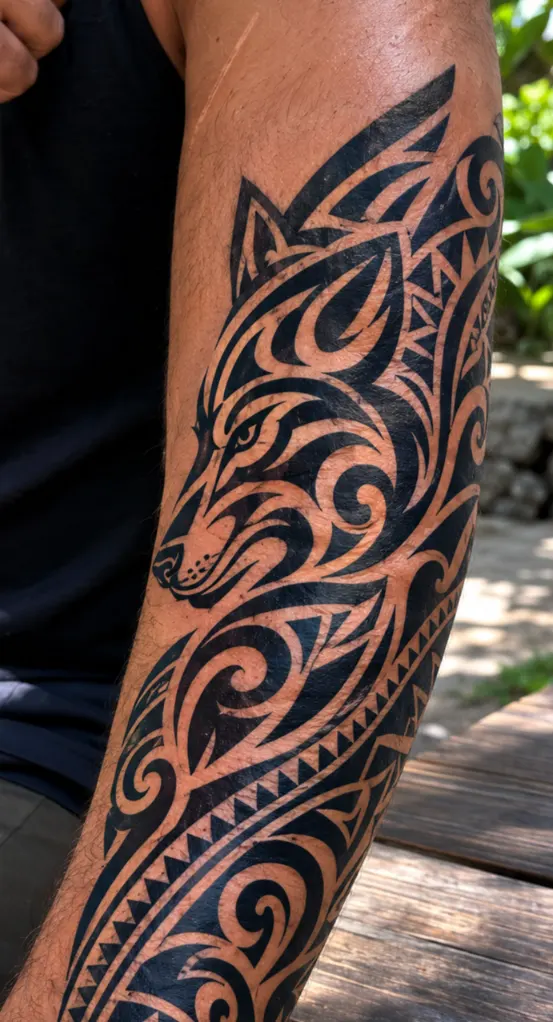
The forearm is a cylinder, and pattern loves a cylinder. A tribal wolf tattoo built from solid black shapes and negative space wraps the arm's curve in a way a flat portrait never can, and it ages like iron because there is no fine gradient to wash out. The same logic carries into heavier modern blackwork, where a wolf is carved out of dense black fill. Both want the outer forearm or a partial wrap, and both reward an artist who designs the pattern to your specific arm rather than stamping a stock template onto it.
Realism: the Showpiece, With a Sun Tax
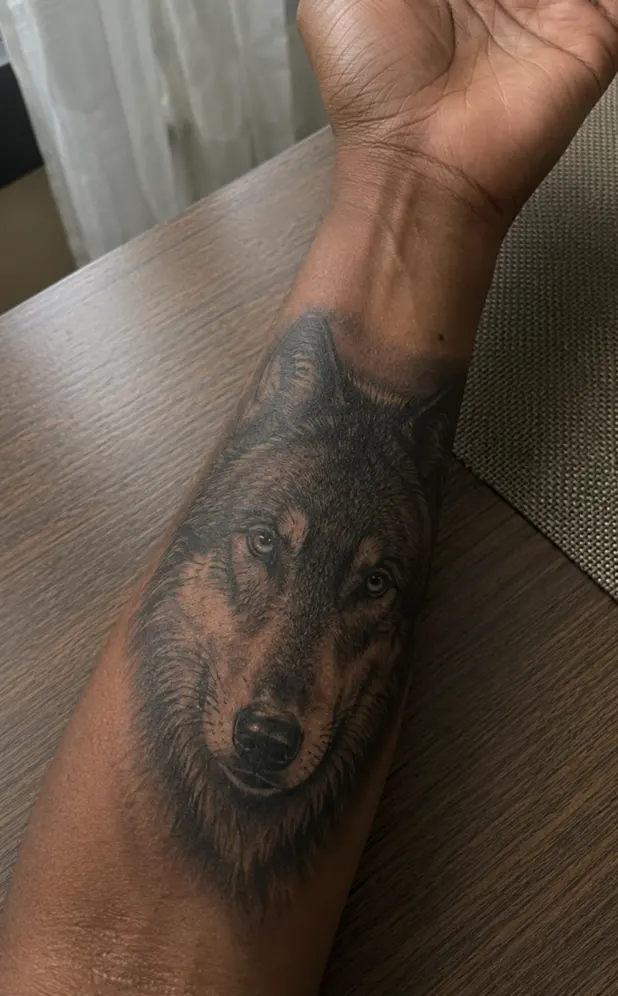
A realistic wolf tattoo is the most jaw-dropping thing you can put on a forearm and the most demanding. A photographic wolf face, every fur strand and a living eye, has the room it needs on the inner forearm especially, where the surface is flat and the skin is smooth. The honest trade-off is the placement's nemesis. Realism is built from fine, low-contrast detail, and the forearm catches more sun than almost anywhere on the body. A PMC review on tattoo sun exposure ties consistent ultraviolet exposure straight to premature fading, which means a realistic forearm wolf needs lifelong sunscreen to stay sharp in a way a bold traditional piece simply does not. Get realism on the forearm if you love it, but go in knowing you are signing up for the maintenance.
Japanese: a Wolf Built to Wrap
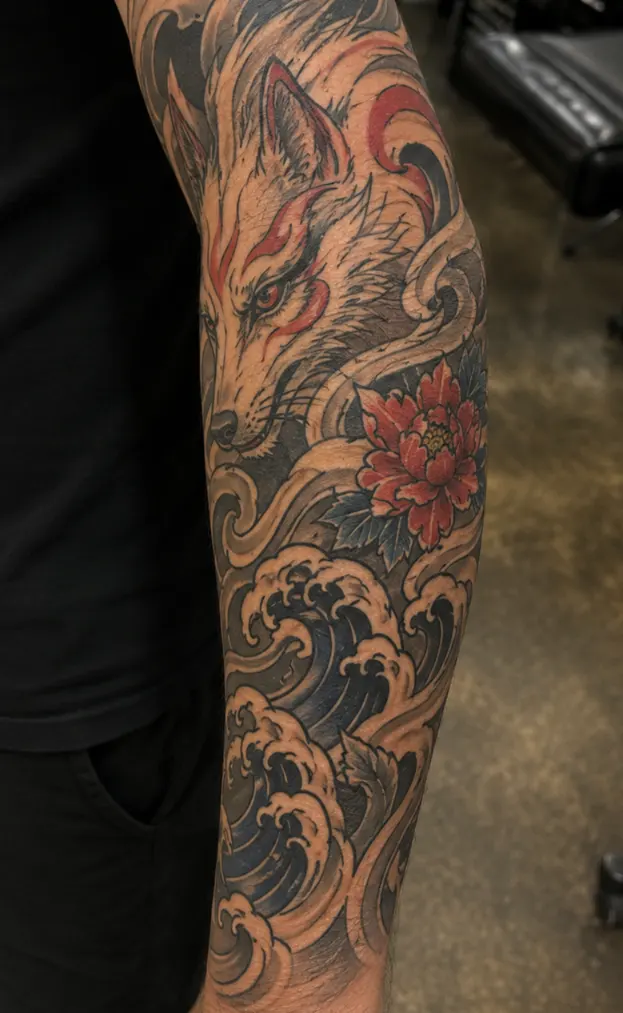
Irezumi, the Japanese style, is designed around the body in a way most Western tattooing is not, which makes it a natural fit for the forearm and the half sleeve it can grow into. The Japanese wolf, the okami, travels with wind bars, waves, clouds and peony or maple elements that flow along and around the arm. Those background motifs are not decoration, they are the connective tissue that makes the piece move with you. A Japanese wolf rarely sits as a lone head; it wants the surrounding world, so it suits people thinking bigger than a single contained tattoo.
Neo-Traditional and Color: Bold Lines, Richer World
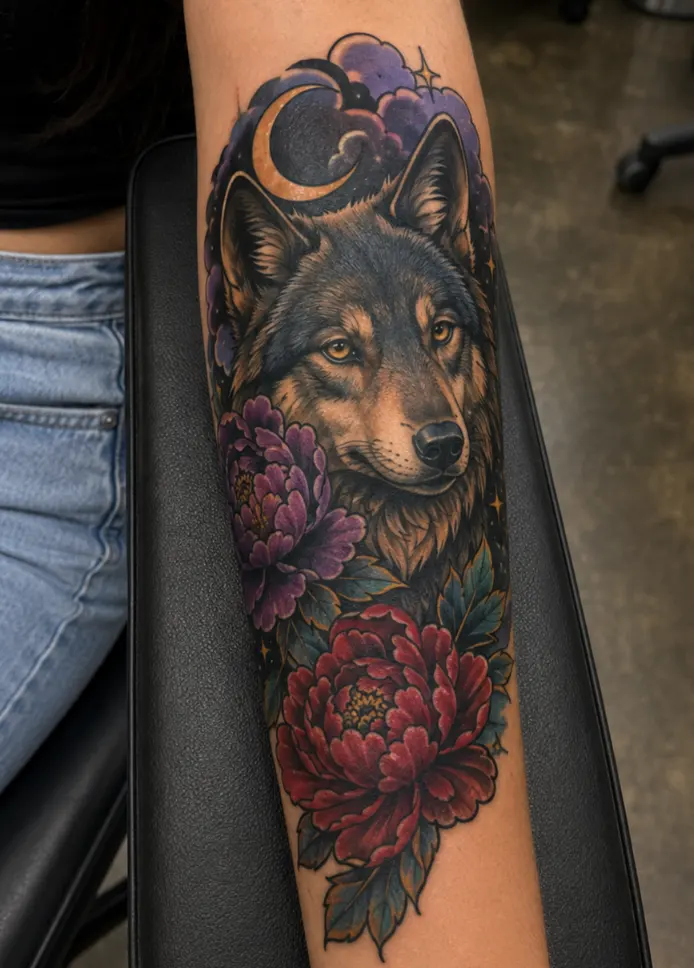
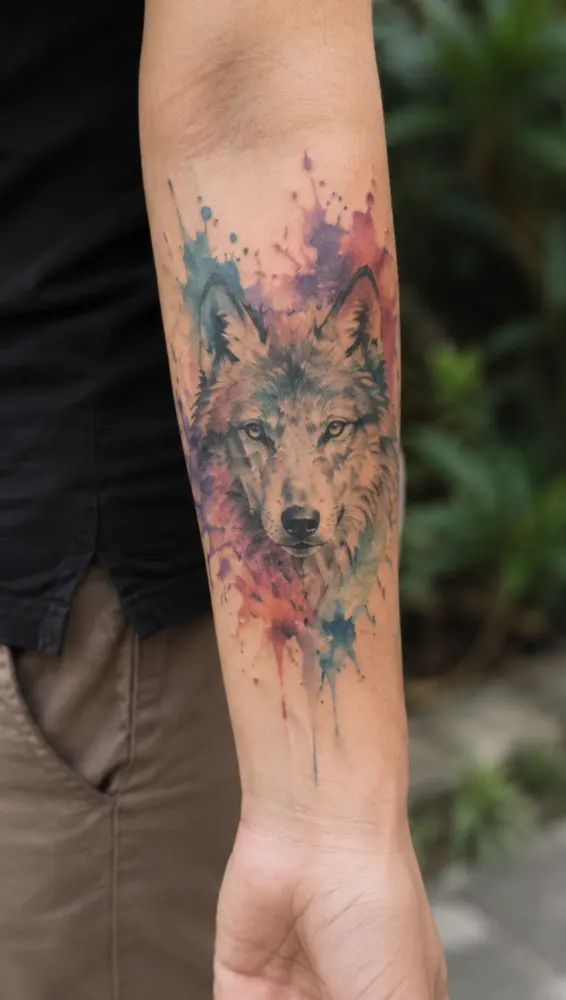
If straight old-school feels too spare but full realism feels too fragile, neo-traditional splits the difference. It keeps a confident outline, which protects it against the forearm's sun, while adding a wider color range, dimensional shading and decorative flourishes like florals, moons or jewelry around the wolf. The bold structure means it holds up better on a sun-exposed arm than delicate color realism, while still giving you the richness and the palette. It is one of the most rewarding ways to do a colorful forearm wolf that will not turn to mud in a decade.
Geometric, Fine Line and the Small End of the Scale
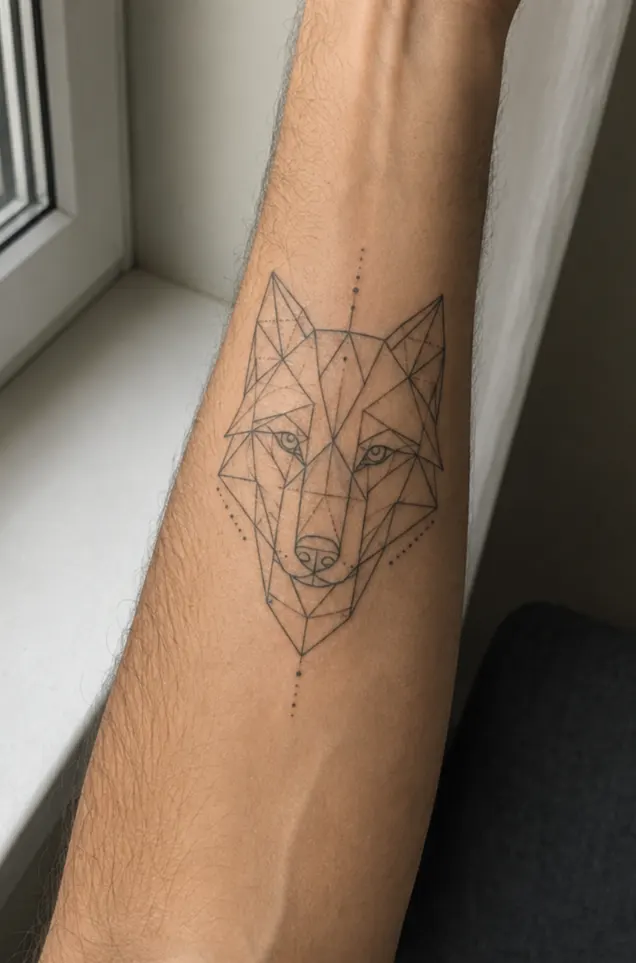
At the cleaner, more modern end, geometric and fine-line wolves suit people who want something quieter. A geometric wolf tattoo built from facets and thin lines reads as contemporary and looks sharp on the inner forearm, while single-line and minimalist wolves work near the wrist where space is tight. Be honest about scale, though. The forearm's real constraint is its width, not its length, and the wrist end is narrow and stings more as the skin thins over bone. Tiny, dense detail packed into a small wrist piece is the fastest way to a blurred wolf in a few years, so if you want small, want simple too. The small wolf tattoo guide covers what genuinely survives at compact sizes, and Healthline's tattoo pain chart backs up why the wrist end and the inner elbow climb the pain scale while the fleshy mid-forearm stays low.

It Does Not Have to Be a Head
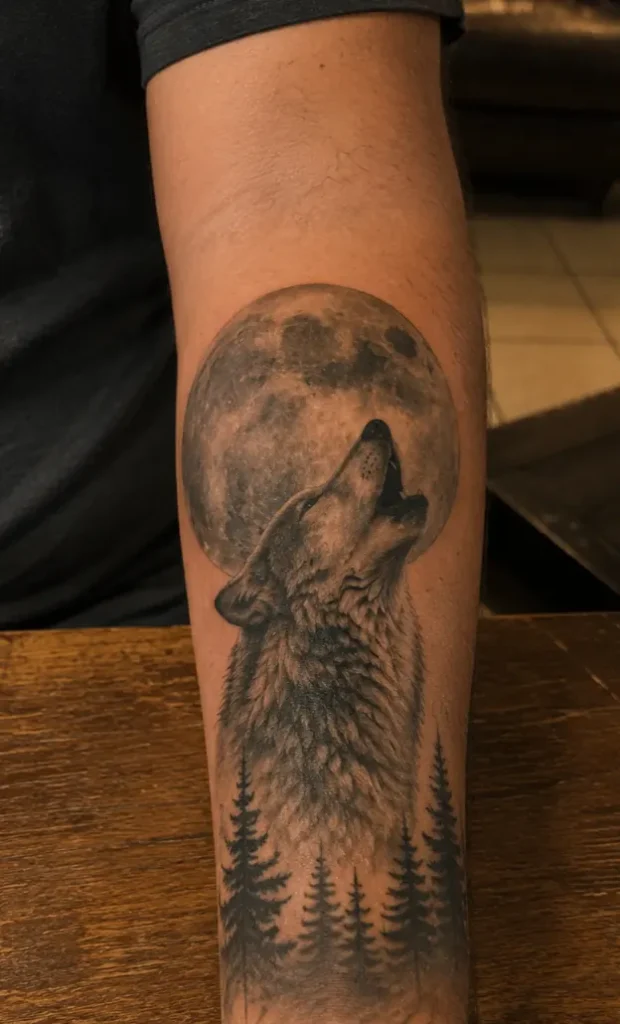
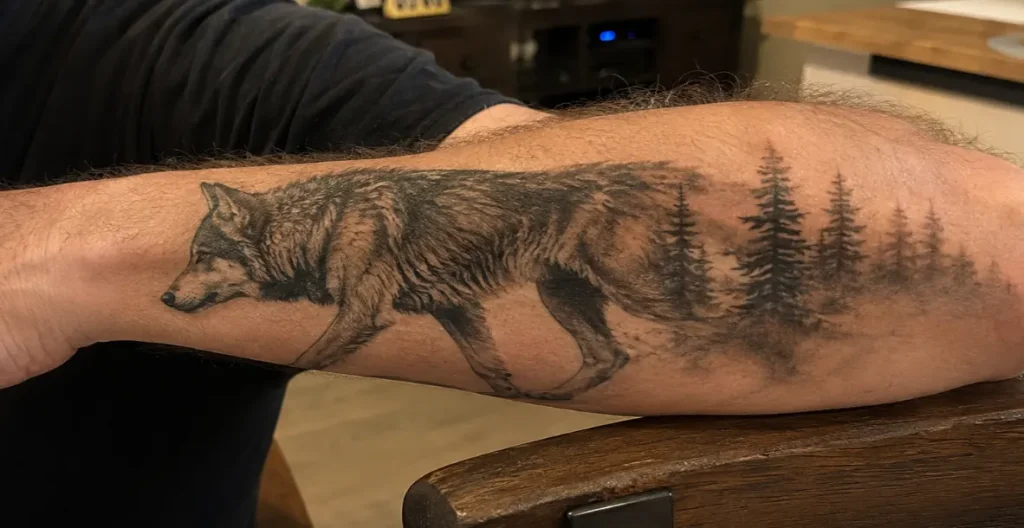
Style is only half the choice. The other half is what the wolf is actually doing, and the forearm's long shape opens up more than a face. A wolf walking or running in profile uses the length of the outer forearm beautifully, the body stretched from wrist to elbow as if mid-stride. A howling wolf tattoo thrown back against a moon is one of the strongest forearm compositions there is, because the clean circle of the moon gives the eye an anchor, and a wolf and moon tattoo with the lunar phases tracking up the inner forearm is a quiet favorite. A wolf fading into a pine forest through negative space turns the lower arm into a small landscape. The point is to match the subject to the arm's geometry: long things run along it, round things like a moon balance it, and a lone head sits best vertically on the inner forearm where it reads upright to you.
Which Way Should It Face? Decide Before the Stencil
Here is the one decision people skip and later regret, and it costs nothing to get right. A forearm wolf can be oriented for you or for everyone else. Facing the wearer, it reads upright when you look down at your own arm, and it tends to live on the inner forearm, the private side. Facing the viewer, it reads correctly to the person across from you and upside down to you, and it tends to live on the outer forearm, the public side. Neither is better, but they say genuinely different things, an intimate reminder versus an outward statement, and the choice cannot be undone without a cover-up. The direction the wolf looks matters too, since a gaze toward the viewer reads as guardianship while a gaze forward reads as a journey, something the wolf tattoo meaning pillar digs into. Settle this with your artist before the stencil goes on, not after.
Living With a Wolf Everyone Can See
Whatever style you land on, the forearm asks one thing the chest or the back never will: are you comfortable with this wolf being visible at every job interview, every formal occasion and every first impression for the rest of your life. If that is an easy yes, the forearm is one of the best placements going. If it makes you hesitate, the inner forearm is the more discreet half, and genuinely hidden options like a wolf chest tattoo or the low-pain, easy-to-cover wolf shoulder tattoo may suit your life better. This weighs differently for different people, and both the wolf tattoos for men and wolf tattoos for women guides get into living with visible work in different worlds.
The sun keeps coming up in this guide because it is the forearm's defining issue, and it deserves a plain answer. This arm is out in daylight more than any other placement, all year. That is why bold styles outlast delicate ones here, and why the single best habit for any forearm wolf is sunscreen on it whenever you are outside; the American Academy of Dermatology is blunt that sun protection is the main lever for keeping any tattoo crisp. During the first few weeks the same arm needs protecting in a different way, since it is a high-use limb that sleeves rub and desks knock. The Cleveland Clinic's aftercare guidance notes the surface heals in two to three weeks while the deeper layers settle for months, so keep a fresh forearm piece out of direct sun entirely while it heals, wear loose sleeves over it, and only move to everyday sunscreen once it has fully settled.
What It Runs
Forearm work is priced like most mid-tier tattooing, and the placement itself is neither cheap nor punishing on the wallet. As a rough 2026 guide for solid mid-tier artists, with big-name artists higher and small towns lower:
| Forearm wolf | Cost range | Sessions | Time |
|---|---|---|---|
| Small piece near the wrist | $120 to $300 | 1 | 1 to 2 hrs |
| Medium inner-forearm wolf head | $350 to $800 | 1 | 3 to 5 hrs |
| Medium outer-forearm walking wolf | $400 to $900 | 1 | 3 to 5 hrs |
| Bold traditional or tribal forearm wolf | $400 to $1,000 | 1 | 3 to 6 hrs |
| Large or detailed forearm portrait | $700 to $1,500 | 1 to 2 | 5 to 8 hrs |
| Full wrist-to-elbow wrap | $900 to $2,200 | 2 to 3 | 7 to 14 hrs |
One honest note on value. The forearm is the placement people are most tempted to cheap out on because it feels casual and visible and easy. Resist that on anything detailed. A wolf that lives on the most public part of you, in the sunlight, for decades, is the last place to shop on price. A wolf has carried weight across cultures for thousands of years, as the Wikipedia overview of wolves in folklore and mythology lays out, and the arm everyone sees is where that weight is on display.
Common Questions
Q: What style of wolf tattoo works best on the forearm?
A: Bold styles wear best because the forearm gets heavy sun. Traditional, tribal and blackwork age the longest thanks to thick lines and solid black. Realism, watercolor and fine color look stunning but need diligent lifelong sunscreen to stay sharp. Japanese and neo-traditional are strong middle options with bold structure plus richer detail.
Q: Inner or outer forearm for a wolf?
A: The outer forearm is the public, lower-pain side, ideal for a walking wolf or a bold piece meant to be seen by others. The inner forearm is the private, slightly more tender side, ideal for a wolf head you read when you look down at your own arm. Choose by how visible you want it.
Q: Which way should a forearm wolf face?
A: Decide before the stencil, because it is permanent. Facing the wearer, it reads upright when you look at your own arm, and usually lives on the inner forearm. Facing the viewer, it reads correctly to people in front of you, and usually lives on the outer forearm. Inner equals intimate, outer equals statement.
Q: Do forearm tattoos fade faster than other placements?
A: Yes, because the forearm is one of the most sun-exposed areas on the body, and ultraviolet light is the main cause of fading. Bold designs plus lifelong sunscreen stay crisp for decades. Fine, low-contrast detail with no sun protection fades fastest, which is why style choice matters so much on this placement.
Q: How much does a wolf forearm tattoo cost?
A small wrist-end wolf runs roughly $120 to $300. A medium forearm wolf runs $350 to $900. A bold traditional or tribal piece runs $400 to $1,000. A large detailed portrait runs $700 to $1,500, and a full wrist-to-elbow wrap runs $900 to $2,200. Artist reputation and city affect the price more than the design.
Q: How big can a wolf forearm tattoo be?
A: Think along the arm, not across it. The forearm's real limit is its narrow width, so designs that run lengthwise work while broad, squat ones get cramped. A wolf head wants several inches of length; if you keep wanting more room, the piece is really asking to become a half sleeve or a full wrap.
So the forearm is not really one decision, it is two. Pick the wolf that is genuinely yours, in whatever style speaks to you, then place and face it for the life you actually live and the sun it will actually sit in. A bold traditional head facing the world on the outer arm and a fine realistic portrait facing you on the inner arm are both right answers; they are just answers to different questions. Settle those, protect it from the sun, and the wolf on your forearm becomes the one you glance at a hundred times a day without thinking, the most ordinary and the most permanent thing you wear. When you are ready to compare the arm against every other spot, the wolf tattoo placements pillar lays it all out, and the wider wolf tattoo hub connects the whole picture.

